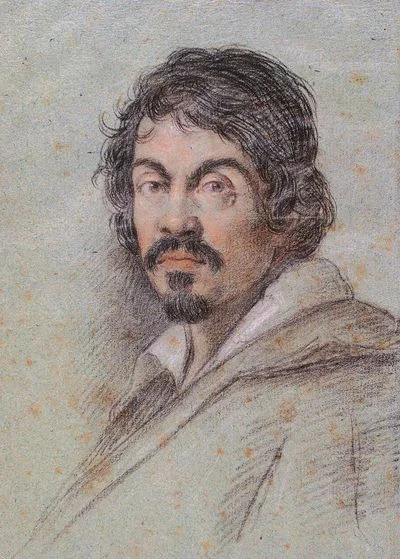
Quick Facts
Master of shadow and scandal. Revolutionized painting with dramatic light — and fled murder charges.
Conversation Starters
Life Journey
Michelangelo Merisi was born on September 29, 1571, in Milan. His father Fermo Merisi served as household administrator to the Marchese of Caravaggio. The family soon fled Milan due to a devastating plague outbreak that would claim his father's life.
The plague that ravaged Milan claimed his father Fermo's life when Caravaggio was only six years old. The family had relocated to their hometown of Caravaggio seeking safety. This early loss would profoundly shape the young artist's life and work.
Caravaggio began a four-year apprenticeship with the Milanese painter Simone Peterzano, a pupil of Titian. He learned the fundamentals of painting in the Lombard tradition, developing his technical skills in oil painting and fresco.
Caravaggio completed his formal training under Peterzano. During these years he absorbed influences from Venetian colorism and Lombard naturalism. He also likely studied the works of Leonardo da Vinci in Milan.
Caravaggio arrived in Rome, the center of the art world. He initially struggled, living in poverty and working for other painters. He produced cheap devotional images and portraits to survive during these difficult early years.
Caravaggio joined the workshop of Giuseppe Cesari, the Cavaliere d'Arpino, one of Rome's most successful painters. He specialized in painting flowers and fruit, developing his extraordinary still-life skills.
Cardinal Francesco Maria del Monte became Caravaggio's first major patron, providing him housing and commissions. This relationship transformed his career, giving him access to Rome's elite.
Caravaggio received his first major public commission: paintings for the Contarelli Chapel in San Luigi dei Francesi. The Calling of Saint Matthew revolutionized religious painting with dramatic realism.
He completed the Conversion of Saint Paul and Crucifixion of Saint Peter for the Cerasi Chapel. These works established his revolutionary tenebrism technique with stark contrasts between light and dark.
Caravaggio's notoriety for brawling and violence grew alongside his artistic fame. Court records document numerous altercations. His volatile temperament became legendary.
The Madonna of Loreto for Sant'Agostino caused sensation with its radical realism, showing the Virgin with dirty feet and common pilgrims kneeling before her.
During a brawl, Caravaggio killed Ranuccio Tomassoni. He fled Rome with a death sentence on his head. This murder transformed him into a fugitive.
Caravaggio fled to Naples where he was welcomed by the Colonna family. He produced some of his darkest works including The Seven Works of Mercy.
Caravaggio traveled to Malta hoping to receive a knighthood. He painted The Beheading of Saint John the Baptist, his largest work and the only painting he ever signed.
Caravaggio was made a Knight of the Order of Malta. However, within months he was arrested after a violent altercation and imprisoned. He escaped under mysterious circumstances.
After escaping Malta, Caravaggio fled to Sicily. Despite being pursued, he continued painting masterpieces including The Burial of Saint Lucy and The Raising of Lazarus.
Returning to Naples, Caravaggio was attacked by unknown assailants, possibly Knights of Malta. He was severely wounded and his face disfigured.
Caravaggio died on July 18, 1610, at Porto Ercole while traveling to Rome. The exact cause remains debated. He was only 38 but had revolutionized European painting forever.