Quick Facts
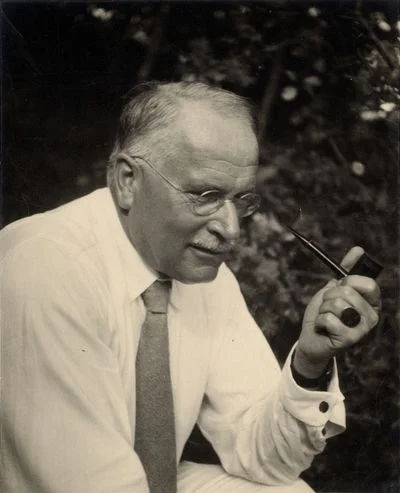
Collective unconscious. Archetypes. Psychiatrist who mapped the depths of the human psyche.
Conversation Starters
Life Journey
Carl Gustav Jung was born to a Protestant pastor and his wife in a small Swiss village. His father's spiritual doubts and his mother's mystical temperament would profoundly influence Jung's lifelong exploration of religion, the unconscious, and the human psyche.
The Jung family relocated to Basel, where Carl experienced recurring dreams and visions that would later inform his theories about the unconscious. He was a solitary, introspective child who felt fundamentally different from others.
Jung experienced a fainting spell that he later analyzed as his first conscious encounter with the power of the unconscious mind. This early psychological crisis sparked his interest in the hidden depths of the human psyche.
Jung enrolled in the University of Basel to study medicine, though he was equally drawn to philosophy, archaeology, and the occult. His medical training would provide the scientific foundation for his later psychological innovations.
After completing his medical degree, Jung joined the prestigious Burghölzli psychiatric clinic under Eugen Bleuler. Here he began pioneering word association experiments that would bring him international recognition and Freud's attention.
Jung married Emma Rauschenbach, daughter of a wealthy industrialist. Emma would become not only his wife and mother of their five children but also his intellectual collaborator, eventually becoming a notable analyst herself.
Jung sent Sigmund Freud his word association studies, initiating a correspondence that would lead to an intense intellectual partnership. Freud saw in Jung his heir apparent, the man who would carry psychoanalysis into the future.
Jung and Freud traveled together to lecture at Clark University, introducing psychoanalysis to America. The seven-week journey revealed growing theoretical differences between the two men that would eventually fracture their relationship.
Jung published 'Transformations and Symbols of the Libido,' radically redefining libido beyond sexuality and introducing his concept of the collective unconscious. The book signaled his theoretical break from Freud.
The final rupture with Freud devastated Jung, triggering a profound psychological crisis. Their correspondence ceased, and Jung resigned from psychoanalytic organizations. The 'father' he had found was now lost.
Jung entered a period of intense self-experimentation he called his 'confrontation with the unconscious.' For six years he deliberately induced visions, recorded his dreams, and explored the depths of his psyche in what became the foundation of analytical psychology.
Jung published 'Psychological Types,' introducing his famous concepts of introversion and extraversion, as well as the four psychological functions. This systematic framework remains influential in personality psychology today.
Jung began building a stone tower at Bollingen on Lake Zurich, a retreat he would expand over decades. He carved inscriptions into the stone walls and used it as a sanctuary for meditation, reflection, and contact with the unconscious.
Jung collaborated with Richard Wilhelm on 'The Secret of the Golden Flower,' a Chinese alchemical text. This marked his deep engagement with Eastern thought, which he saw as parallel to his discoveries about the Western unconscious.
Jung established the psychological club that would become the C.G. Jung Institute, training analysts in his methods. His international reputation grew as students from around the world came to study with him.
After a heart attack, Jung had a profound near-death experience involving cosmic visions. He later described this as the most tremendous experience of his life, after which he felt liberated to write and think more freely.
Emma Jung died after 52 years of marriage. Her death left Jung bereft, though he continued working productively into his final years, completing 'Mysterium Coniunctionis' and collaborating on his autobiography.
Carl Jung died peacefully at his lakeside home, having revolutionized our understanding of the psyche. His concepts of archetypes, collective unconscious, individuation, and psychological types continue to shape psychology, literature, and culture worldwide.