Quick Facts
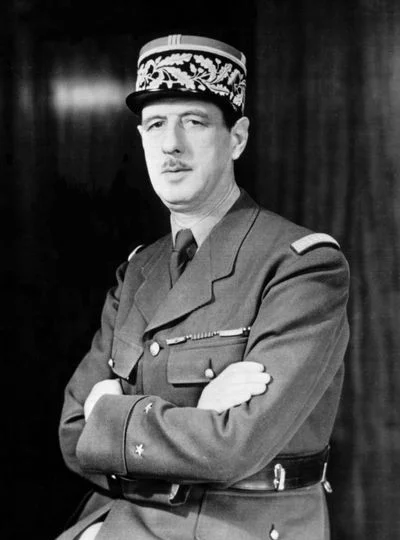
France, above all!" World War II hero, Fifth Republic founder.
Conversation Starters
Life Journey
Charles André Joseph Marie de Gaulle was born into a Catholic, patriotic family. His father was a teacher who instilled in him a deep love of French history and a conviction that France had a unique destiny among nations.
De Gaulle enrolled in France's elite military academy, determined to serve his country. He graduated in 1912, ranked thirteenth in his class, and was assigned to an infantry regiment commanded by Colonel Philippe Pétain.
De Gaulle entered the Great War as a young lieutenant. He was wounded three times and captured at the Battle of Verdun in 1916 after fierce hand-to-hand combat. He spent nearly three years as a prisoner of war, making five failed escape attempts.
De Gaulle married Yvonne Vendroux, beginning a devoted partnership that would last until his death. Their daughter Anne, born with Down syndrome, became the center of their family life, and de Gaulle showed her exceptional tenderness throughout her life.
De Gaulle published 'Vers l'Armée de métier,' advocating for a professional army with modern tanks and aircraft. French military leaders ignored his revolutionary ideas, but German commanders studied them carefully for their blitzkrieg tactics.
As France collapsed before the German onslaught, de Gaulle led the 4th Armored Division in one of the few successful French counterattacks. He was promoted to brigadier general—the youngest in the French army—and briefly served as undersecretary of war.
After France's surrender, de Gaulle flew to London and broadcast his famous appeal refusing to accept defeat: 'France has lost a battle, but France has not lost the war.' This defiant moment made him the symbol of French resistance.
De Gaulle organized the Free French Forces from London, battling not only the Nazis but also Roosevelt and Churchill who often tried to sideline him. Through sheer willpower, he kept France's claim to great power status alive during the occupation.
De Gaulle walked down the Champs-Élysées before a million cheering Parisians on August 26, 1944, just days after the city's liberation. He famously declared 'Paris outraged! Paris broken! Paris martyred! But Paris liberated!' establishing his moral authority.
Frustrated by the return of squabbling parliamentary politics, de Gaulle abruptly resigned as provisional president. He retreated to his home in Colombey-les-Deux-Églises, beginning what he called his 'crossing of the desert.'
As France teetered on the brink of civil war over Algeria, de Gaulle was called back to power. He demanded and received extraordinary authority to draft a new constitution, ending the Fourth Republic and establishing presidential power.
De Gaulle created the Fifth Republic with a strong presidency at its center, the constitutional framework that governs France to this day. Elected president by an electoral college, he began reshaping French politics and foreign policy.
De Gaulle narrowly survived an assassination attempt by the OAS at Petit-Clamart when over 150 bullets riddled his car. He calmly brushed glass from his jacket, remarking that the shooters were 'poor shots.' This was the most serious of over 30 attempts on his life.
De Gaulle pulled France out of NATO's integrated military command, asserting French independence from American dominance. He pursued an independent nuclear deterrent and sought to position France as a third force between the superpowers.
Student protests and a general strike brought France to a standstill. De Gaulle secretly flew to Germany to consult with the French army, then returned to rally his supporters. His broadcast turned the tide, and Gaullists won a landslide election.
After voters rejected his referendum on regional reform, de Gaulle immediately resigned, true to his promise that he would leave if France rejected him. He retreated to Colombey to write his memoirs.
Charles de Gaulle died suddenly of a heart attack while playing solitaire. Per his wishes, he was buried in a simple grave in the village cemetery, with only family present. Meanwhile, world leaders gathered at Notre-Dame for a memorial mass for the man who had saved France's honor.