Quick Facts
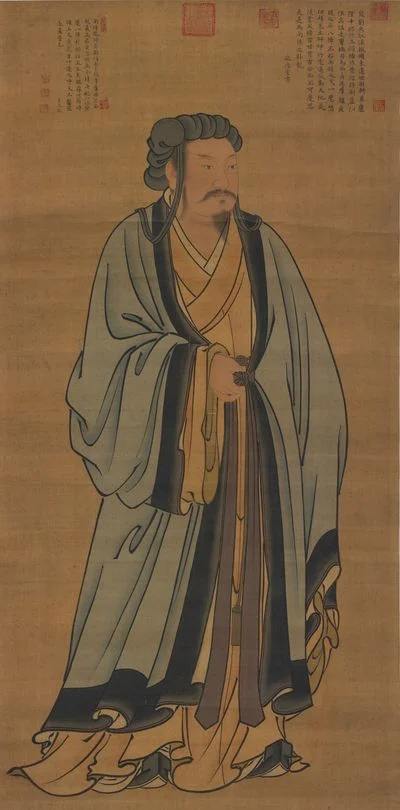
Sleeping Dragon. China's legendary strategist whose brilliance became the stuff of legend.
Conversation Starters
Life Journey
Zhuge Liang was born into a scholarly family during the late Eastern Han Dynasty. His father Zhuge Gui was a minor official, and the family had a tradition of learning and service.
The Yellow Turban Rebellion erupted across China, marking the beginning of chaos that would eventually lead to the fall of the Han Dynasty. Young Zhuge Liang's world was shaped by this turmoil.
Zhuge Liang's father died when he was young, and he was raised by his uncle Zhuge Xuan. The chaos of the time forced the family to flee south, eventually settling in Jing Province.
After his uncle's death, Zhuge Liang chose to live as a farmer-scholar in Longzhong. He spent years in deep study of military strategy, governance, and classical texts while observing the world's events.
Zhuge Liang married Huang Yueying, daughter of the local scholar Huang Chengyan. Despite being called unattractive, she was renowned for her intelligence and is said to have contributed to his inventions.
Zhuge Liang earned the nickname 'Wolong' (Sleeping Dragon) for his hidden talents and strategic brilliance. Along with Pang Tong, known as the Young Phoenix, he was considered one of the greatest minds of the era.
Warlord Liu Bei visited Zhuge Liang's thatched cottage three times to request his service. Impressed by Liu Bei's sincerity and virtue, Zhuge Liang agreed to serve him, presenting his famous Longzhong Plan.
Zhuge Liang outlined his grand strategy for Liu Bei to unite the empire: secure Jing Province, take Yi Province (Sichuan), ally with Sun Quan against Cao Cao, and eventually restore the Han Dynasty.
As envoy to Sun Quan's court, Zhuge Liang persuaded the Eastern Wu to ally with Liu Bei against Cao Cao's overwhelming forces. His diplomatic skill was crucial to forming this alliance.
The allied forces of Liu Bei and Sun Quan defeated Cao Cao's massive army at the Battle of Red Cliffs. Legend attributes many strategic innovations to Zhuge Liang, including borrowing arrows with straw boats.
Liu Bei's forces conquered Yi Province (modern Sichuan), fulfilling a key part of the Longzhong Plan. Zhuge Liang was instrumental in managing logistics and governance during this campaign.
Liu Bei declared himself Emperor of Shu Han after Cao Cao's son usurped the Han throne. Zhuge Liang became Chancellor, responsible for all military and civil administration of the new kingdom.
Liu Bei died after his disastrous campaign against Eastern Wu. On his deathbed, he entrusted his son Liu Shan and the kingdom to Zhuge Liang, who became regent and the de facto ruler of Shu Han.
Zhuge Liang led a campaign to pacify the southern Nanman tribes. He captured and released the Nanman leader Meng Huo seven times, winning his genuine submission through benevolence rather than force.
Zhuge Liang presented his famous memorial 'Chu Shi Biao' (First Memorial on Dispatching the Army) to Liu Shan before launching his first Northern Expedition against Wei. It remains a literary masterpiece expressing loyalty.
The first Northern Expedition failed when Ma Su lost the crucial Jieting stronghold. Zhuge Liang tearfully executed his protege Ma Su for disobeying orders, demonstrating his commitment to military discipline.
Zhuge Liang invented the 'wooden ox and gliding horse,' innovative transport vehicles to solve supply problems in the mountainous terrain. His inventions also included the repeating crossbow and Kongming lanterns.
Zhuge Liang launched his fifth and final Northern Expedition. He faced off against Wei general Sima Yi at Wuzhang Plains in a prolonged stalemate, as Sima Yi refused to engage the Shu forces directly.
Years of overwork took their toll on Zhuge Liang's health. He fell gravely ill during the campaign but continued working tirelessly, reportedly reviewing military documents by candlelight until the end.
Zhuge Liang died at Wuzhang Plains at age 53, his dream of restoring the Han Dynasty unfulfilled. His last words arranged the orderly retreat of the Shu army. He became an immortal symbol of loyalty and wisdom in Chinese culture.