Quick Facts
Being and Nothingness" author; Hegel: History progresses through clashing ideas.
Conversation Starters
Life Journey
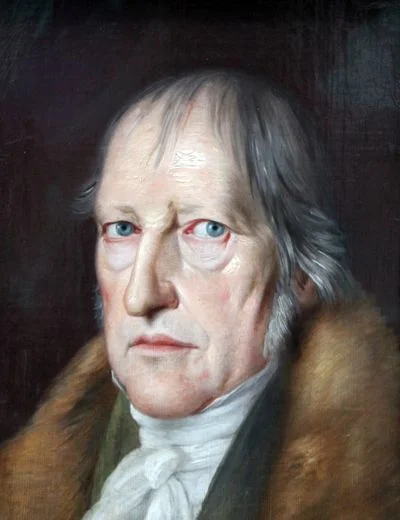
Georg Wilhelm Friedrich Hegel was born to a civil servant family in the Duchy of Württemberg. His comfortable bourgeois upbringing and excellent education at Stuttgart's gymnasium prepared him for university studies in philosophy and theology.
Hegel entered the Tübingen Stift, a Protestant seminary, sharing a room with future luminaries Schelling and Hölderlin. Together they debated philosophy and celebrated the French Revolution, planting a tree of liberty in the seminary garden.
After completing his studies, Hegel became a private tutor in Bern. During these years of intellectual isolation, he wrote unpublished works on religion and began developing the ideas that would eventually become his philosophical system.
Hegel moved to Frankfurt as a tutor, reuniting with Hölderlin. He continued writing on religion and society while inheriting money from his father that would allow him to pursue an academic career. His philosophical ambitions were taking clearer shape.
Hegel moved to Jena to begin an academic career, joining Schelling in Germany's most vibrant philosophical center. He became a lecturer at the university and began publishing, though initially in Schelling's shadow.
Hegel finished his first major work as Napoleon's armies approached Jena. The 'Phenomenology' traced consciousness's development from simple awareness to Absolute Knowledge, introducing the dialectical method that would transform philosophy.
After Napoleon defeated Prussia at Jena, Hegel saw the Emperor riding through the city. He wrote that he had seen 'the World Spirit on horseback,' understanding Napoleon as history's instrument. The battle also scattered his manuscript pages.
Hegel became headmaster of a gymnasium in Nuremberg, where he taught philosophy to secondary students. During these eight years of stability, he systematically developed his logic and married Marie von Tucher, finally achieving domestic happiness.
Hegel published the first volume of his 'Science of Logic,' developing his dialectical method through the movement of pure thought. The work was notoriously difficult but established him as Germany's leading philosopher after Kant.
Hegel finally received a university professorship at Heidelberg. He published the 'Encyclopedia of the Philosophical Sciences,' a comprehensive overview of his entire system covering logic, nature, and spirit in compact form.
Hegel was appointed to Fichte's former chair at the University of Berlin, the most prestigious philosophical position in Germany. He would spend the rest of his life there, becoming the dominant intellectual figure of his age.
Hegel's political philosophy appeared, analyzing law, morality, and ethical life. The famous preface declared that philosophy 'paints its grey in grey' only when a form of life has grown old. The work defended rational elements in the Prussian state.
Hegel delivered his celebrated lectures on aesthetics, analyzing the historical development of art from ancient to modern times. He argued that art expresses spiritual truth in sensuous form, though religion and philosophy supersede it in modern life.
Hegel's lectures interpreted the history of philosophy as the progressive realization of reason. Each philosopher advanced thought dialectically, with Greek philosophy, medieval theology, and modern philosophy forming necessary stages toward Absolute Knowledge.
Hegel was elected rector of the University of Berlin, the pinnacle of academic recognition. His philosophical school dominated German intellectual life, with disciples occupying chairs throughout the country and debating his legacy's implications.
Hegel died suddenly during a cholera epidemic, though whether from cholera or a chronic stomach ailment remains unclear. He was buried beside Fichte as he wished. His system fragmented into rival schools, but his influence on Marx, existentialism, and continental philosophy proved permanent.