Quick Facts
World-class charmer, Casanova: Escaped prison, wrote memoirs, conquered hearts.
Conversation Starters
Life Journey
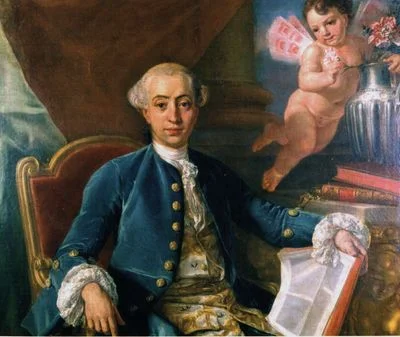
Giacomo Girolamo Casanova was born on April 2, 1725, in Venice. Both his parents were actors, though his biological father may have been a nobleman. His childhood was marked by illness and family instability.
Young Casanova was sent to a boarding house in Padua, where he began his formal education. He studied at the University of Padua, showing exceptional intelligence and earning a law degree at just seventeen.
Casanova received his doctorate in civil and canon law from the University of Padua. Despite his education, he showed little interest in a legal career, preferring a life of adventure.
Casanova entered the Church as an abbe, serving as secretary to Cardinal Acquaviva in Rome. His scandalous behavior soon ended this career path.
After various misadventures, Casanova became a professional violinist in the San Samuele theater in Venice. This period marked the beginning of his legendary romantic exploits.
Casanova saved the life of Venetian senator Matteo Giovanni Bragadin during a stroke. Bragadin became his patron and surrogate father, providing financial support for years.
Casanova conducted affairs with the nuns M.M. and C.C. at the convent of Santa Maria degli Angeli, one of his most famous and scandalous liaisons documented in his memoirs.
The Venetian Inquisition arrested Casanova for practicing magic and maintaining a libertine lifestyle. He was imprisoned in the Leads, the notorious prison under the roof of the Doge's Palace.
Casanova achieved one of history's most famous prison escapes, breaking through the ceiling of his cell and escaping across the roof of the Doge's Palace. The escape made him a legend.
After his escape, Casanova traveled through Europe, moving in the highest social circles. In Paris, he helped establish the French lottery and amassed a fortune.
Casanova conducted an elaborate scheme involving the wealthy Marquise d'Urfe, who believed in alchemy. He convinced her he could help her be reborn as a man through magical rituals.
After his schemes were exposed, Casanova was forced to leave Paris. He traveled through Europe, meeting figures like Voltaire, Frederick the Great, and Catherine the Great.
Casanova visited Voltaire at Ferney and engaged in philosophical discussions with the great thinker. Their conversations revealed Casanova's considerable intellectual abilities.
Casanova fought a pistol duel with Polish nobleman Franciszek Branicki over an Italian actress. Though wounded, he survived and the affair enhanced his reputation.
After years of exile, Casanova received permission to return to Venice. He worked as a spy for the Venetian Inquisitors of State, reporting on fellow citizens.
After publishing a satire that offended a noble family, Casanova was forced to leave Venice again, this time permanently.
Casanova became librarian to Count Waldstein at Dux Castle in Bohemia. He spent his final years there, writing his memoirs.
Giacomo Casanova died on June 4, 1798. He left behind his famous memoirs, Histoire de ma vie, one of the most authentic sources on 18th-century European customs and society.