Quick Facts
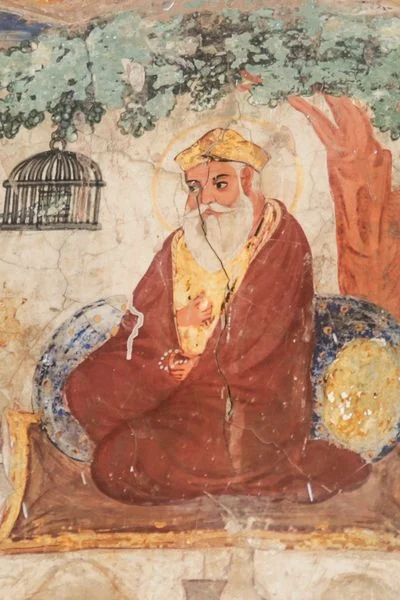
There is no Hindu, no Muslim. Founded Sikhism on the truth that all are equal before God.
Conversation Starters
Life Journey
Guru Nanak was born to Mehta Kalu and Mata Tripta in a Hindu family, destined to found Sikhism and transform Indian spirituality.
Young Nanak began his education, quickly mastering Sanskrit, Persian, and Arabic while showing extraordinary spiritual insight.
Nanak took employment managing the storehouse of the local Muslim governor, gaining a reputation for honesty and generosity.
Nanak married Sulakhni and later had two sons, Siri Chand and Lakhmi Das, though he would soon feel called to spiritual mission.
Nanak began his first great journey (Udasi) traveling eastward, visiting Hindu pilgrimage sites and spreading his message of unity.
Nanak disappeared into the Vein River for three days, emerging with divine revelation and declaring: 'There is no Hindu, no Muslim.'
Nanak met the renowned Sufi saint Pir Dastgir in Baghdad, engaging in profound spiritual discourse that impressed Islamic scholars.
Nanak founded Kartarpur as a model community where people of all castes and faiths lived together in equality and shared worship.
Nanak embarked on his second great journey southward, visiting Hindu temples and engaging with saints across South India.
Nanak visited Mecca and Medina, reportedly challenging religious orthodoxy by sleeping with his feet toward the Kaaba.
Nanak journeyed north into the Himalayas and Tibet, meeting Buddhist monks and siddhas in remote mountain monasteries.
Nanak's final major journey took him west to Persia and Central Asia, spreading his teachings across the Islamic world.
Nanak settled permanently in Kartarpur, establishing the Sikh institutions of langar (community kitchen) and sangat (congregation).
Nanak selected Bhai Lehna, renaming him Angad, as his spiritual successor, establishing the tradition of Sikh Gurus.
Guru Nanak merged with the Divine Light, leaving a unified community that transcended Hindu and Muslim divisions.