Quick Facts
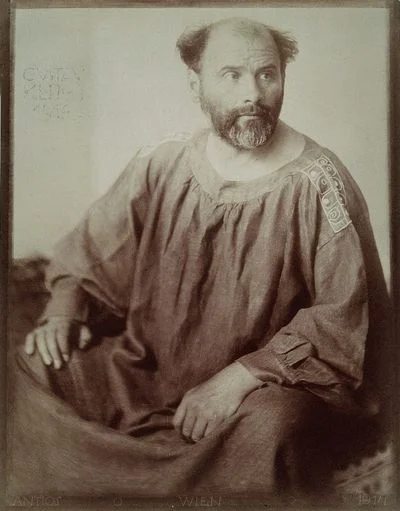
"Kiss" painter: Vienna's golden, erotic Art Nouveau master.
Conversation Starters
Life Journey
Gustav Klimt was born to Ernst Klimt, a gold engraver, and Anna Klimt in a suburb of Vienna, destined to become Austria's greatest painter.
Klimt enrolled at the Vienna School of Arts and Crafts, beginning seven years of training in architectural painting.
Klimt founded the 'Company of Artists' with his brother Ernst and friend Franz Matsch, accepting commissions for murals and decorations.
Klimt completed his formal education and began receiving major commissions for public building decorations in Vienna.
Emperor Franz Joseph I awarded Klimt the Golden Order of Merit for his murals in the Burgtheater, establishing his reputation.
Klimt suffered the devastating loss of both his father and brother Ernst, profoundly affecting his artistic vision and style.
Klimt received the prestigious commission to paint ceiling panels for the University of Vienna, later causing major controversy.
Klimt co-founded the Vienna Secession movement, becoming its first president and leader of Austria's Art Nouveau revolution.
Klimt's controversial 'Philosophy' painting was exhibited at the Paris World Fair, winning a gold medal despite criticism in Vienna.
Klimt traveled to Ravenna and was deeply inspired by Byzantine mosaics, leading to his famous 'Golden Phase' style.
Klimt left the Vienna Secession following internal disputes, taking several followers to form a more avant-garde group.
Klimt completed his masterpiece 'Portrait of Adele Bloch-Bauer I', the golden portrait that would become Austria's 'Mona Lisa'.
Klimt painted 'The Kiss', his most celebrated work featuring gold leaf, embodying the height of his Golden Phase.
Klimt's allegorical masterpiece 'Death and Life' won first prize at the International Art Exhibition in Rome.
Gustav Klimt died from a stroke following the Spanish flu, leaving several paintings unfinished, including his famous portraits.