Quick Facts
Master of Northern Renaissance realism who shaped Tudor imagery with incisive portraits, elegant design, and sharp political awareness.
Conversation Starters
Life Journey
Born in Augsburg, he grew up in the workshop culture of a major German trading city. His father, Hans Holbein the Elder, trained him early in drawing, panel painting, and late-Gothic craft traditions.
Holbein and his brother Ambrosius relocated to Basel, a booming printing center on the Rhine. The city’s scholars and publishers offered steady work for illustrators and introduced him to humanist networks.
He began taking commissions for painted signs, book ornaments, and small panels while building local patrons. Basel’s guild system shaped his professional identity and placed him close to printers and civic leaders.
Holbein produced designs for woodcuts and title pages that fit Basel’s fast-paced publishing industry. These collaborations honed his clear line, compressed storytelling, and ability to communicate complex ideas visually.
He married Elsbeth Binsenstock, a Basel widow with an established household, and they formed a family over the next years. The marriage anchored him socially, even as later travel and court life pulled him away.
Holbein completed ambitious altarpieces and devotional panels for Basel churches, combining Italianate balance with Northern precision. As reform tensions rose, his sacred art sat at the center of a city debating images and worship.
He designed scenes for the 'Dance of Death' series, pairing dark humor with moral urgency about wealth, status, and mortality. The images later circulated widely in print, spreading his reputation far beyond Basel.
Facing uncertainty in Basel’s changing religious climate, he traveled to France to find commissions. Time in French artistic circles broadened his courtly style and reinforced the value of portraiture as social currency.
With a letter from Desiderius Erasmus, Holbein went to England and entered the circle of Thomas More. In More’s household at Chelsea he painted portraits that fused humanist intellect with striking physical presence.
He portrayed scholars, diplomats, and London merchants linked to the Steelyard, capturing fabrics, metals, and faces with forensic care. These portraits established him as the most desirable painter for those navigating Tudor power.
Holbein went back to Basel as religious reforms intensified and images were increasingly contested. He sought civic stability through official work, but the shrinking market for church art pushed him toward portrait-led patronage.
He returned to London and secured commissions from German merchants at the Hanseatic Steelyard. Their international connections paid well and gave him access to materials, sitters, and diplomatic channels.
For Jean de Dinteville and Georges de Selve, he composed a dense still-life of instruments, books, and symbols of learning and faith. The distorted skull, readable from an angle, turned the portrait into a meditation on mortality and power.
Holbein entered royal service as King's Painter, supplying portraits and designs that supported Henry VIII’s dynastic image. He worked within a court transformed by the break with Rome, where art functioned as statecraft and propaganda.
He painted Jane Seymour and created enduring likenesses of Henry VIII that fixed the king’s commanding presence in popular memory. These works aligned with the need to project stability after Anne Boleyn’s fall and amid succession fears.
Holbein traveled and produced portrait studies used to evaluate potential brides and alliances for Henry VIII. His images became tools of foreign policy, where likeness, reputation, and negotiation were tightly intertwined.
In Brussels he portrayed Christina of Denmark with cool restraint, balancing elegance with psychological distance. The portrait circulated at court as a diplomatic document, shaping discussions among Henry VIII and his advisers.
His portrait of Anne of Cleves was part of the negotiation that led to her brief marriage to Henry VIII. After the annulment and Thomas Cromwell’s fall, Holbein remained employed, showing careful adaptation to court politics.
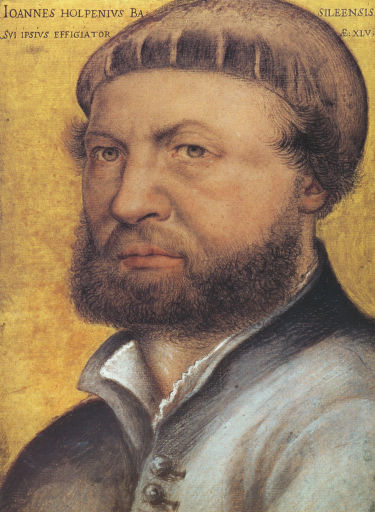
Holbein died in London during a period marked by recurrent plague and high mortality. He left unfinished commissions and a legacy of drawings and portraits that defined the face of Tudor England for later generations.