Quick Facts
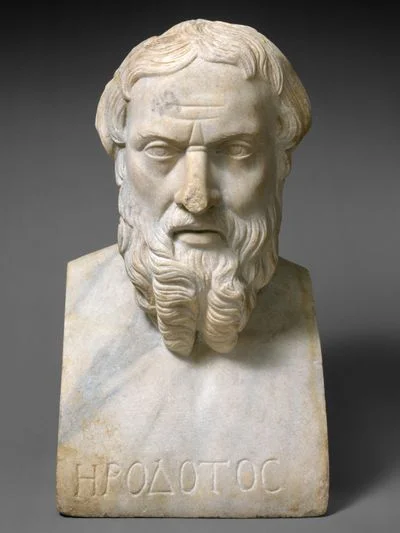
Father of History. First to investigate the past systematically — and tell great stories doing it.
Conversation Starters
Life Journey
Herodotus was born in the Greek city of Halicarnassus, then under Persian rule. His family was prominent and cultured, providing him with an excellent education in Greek literature and philosophy.
Young Herodotus received education in Homer's epics, Greek mythology, and the works of early philosophers. This foundation shaped his approach to understanding history and culture.
Herodotus was exiled from his hometown due to his family's involvement in a failed uprising against the tyrant Lygdamis. He moved to the island of Samos, beginning his life as a traveler.
Herodotus traveled extensively through Egypt, visiting Memphis, Thebes, and the pyramids at Giza. He documented Egyptian customs, religion, geography, and history, devoting an entire book to Egypt.
He journeyed to Babylon and other parts of the Persian Empire, observing their customs, architecture, and governance. His accounts provide valuable insights into ancient Near Eastern civilizations.
Herodotus traveled to the lands north of the Black Sea, documenting the nomadic Scythian peoples. His descriptions of their customs and way of life remain valuable historical sources.
Herodotus settled in Athens during its Golden Age under Pericles. He became part of the intellectual circle that included Sophocles, and he began organizing his vast collection of research.
Herodotus gave public readings of his historical research in Athens, receiving acclaim. Ancient sources claim he was awarded a substantial sum for these performances at the Panathenaic festival.
Herodotus joined the Athenian-sponsored colonization of Thurii in southern Italy. He became a citizen of this new city and spent significant time there while continuing his historical work.
Herodotus began the systematic compilation of his magnum opus, The Histories, weaving together decades of research, travel observations, and oral testimonies into a coherent narrative.
The central focus of The Histories was the account of the Greco-Persian Wars, including the battles of Marathon, Thermopylae, Salamis, and Plataea. He interviewed veterans and visited battle sites.
Herodotus completed major portions of his nine-book work, covering not only warfare but also geography, ethnography, and the customs of numerous peoples from Greece to India.
Herodotus pioneered historical methodology by distinguishing between what he witnessed, what he heard from others, and what he believed to be true. He often presented multiple versions of events.
Herodotus became recognized as the Father of History, a title later given by Cicero. His work represented the first systematic attempt to document and explain historical events.
In his final years, Herodotus continued refining his work in Thurii. Ancient sources describe him as a respected elder in the community, known for his vast knowledge of the world.
Herodotus died in Thurii, leaving behind The Histories, a work that would influence all subsequent Western historiography. His grave was reportedly honored in the marketplace of Thurii.