Quick Facts
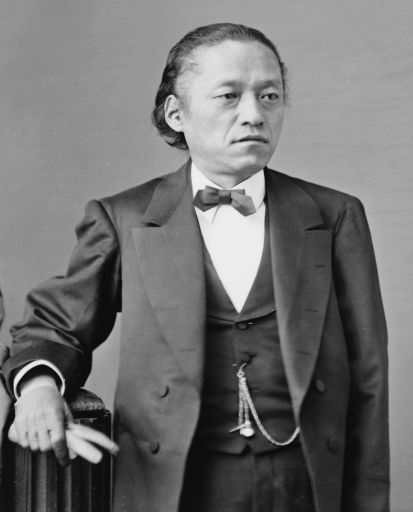
Court noble-turned-statesman who guided Japan’s Meiji transformation, championing constitutional government and modern diplomacy after 1868.
Conversation Starters
Life Journey
Born in Kyoto during the late Tokugawa period, he was raised within the refined but politically constrained world of court nobility. Early education emphasized classical learning and court protocol, shaping his later role as an imperial statesman.
He entered the Iwakura household, a branch of the Kyoto aristocracy, securing status and connections at the imperial court. The adoption positioned him to serve in court offices where he could influence imperial decisions as crisis approached.
News of Commodore Matthew Perry’s arrival and the opening treaties intensified debate in Kyoto about sovereignty and diplomacy. He studied the shifting balance between the shogunate and the court, concluding Japan needed political reorganization to survive.
By the early 1860s he became a key court figure, working to strengthen imperial authority amid violence and factionalism. He cultivated ties with reform-minded domains such as Satsuma and Choshu, linking court legitimacy with military power.
As anti-foreign activism surged, he tried to channel imperial sentiment away from reckless confrontation and toward coordinated state-building. The clashes around Kyoto highlighted how fragile order had become and how urgently a new national government was needed.
Court struggles and domain rivalries led to his removal and temporary seclusion, cutting him off from direct influence. The episode taught him the risks of factional politics and reinforced his preference for disciplined, centralized decision-making.
As Tokugawa Yoshinobu moved toward resigning governing authority, he re-entered court politics to shape the transition. He pressed for a decisive restoration of imperial rule rather than a compromise that left power fragmented among competing elites.
Following the Meiji Restoration, he became a central figure in forming the new administration around Emperor Meiji. He backed sweeping reforms to replace Tokugawa institutions, aiming to unify authority and present Japan as a modern sovereign state.
He supported policies that persuaded daimyo to return their domains to the emperor, reducing feudal autonomy. The move strengthened the central treasury and paved the way for nationwide governance, taxation, and conscription under Tokyo’s direction.
He backed the abolition of han and the establishment of prefectures, a cornerstone of Meiji centralization. The reform dismantled hereditary domain power and made local administration answerable to the national government, accelerating modernization efforts.
He headed a major embassy that traveled through the United States and Europe with leaders like Okubo Toshimichi and Ito Hirobumi. The delegation studied schools, industries, armies, and constitutions, realizing treaty revision required deeper modernization first.
In Britain, France, and other capitals, he observed parliamentary practice, finance, and imperial power firsthand. Meetings with officials and factory visits convinced him Japan needed modern law, infrastructure, and education to negotiate as an equal.
After returning, he resisted calls by Saigo Takamori and others to launch a punitive expedition to Korea. He argued the state needed fiscal stability, military reform, and diplomatic leverage first, helping avert a potentially disastrous early war.
He worked closely with allies such as Okubo Toshimichi to keep modernization priorities on track after internal splits. The government pushed forward administrative consolidation and institutional building while managing growing discontent among former samurai.
When Saigo Takamori’s uprising erupted, he backed decisive national mobilization to defend the new order. The conflict tested Meiji conscription and finances, and its outcome strengthened the legitimacy of centralized government over domain militarism.
Amid the Freedom and People’s Rights Movement and factional disputes, he supported a clear commitment to a future constitution and national assembly. The pledge helped stabilize politics by setting a timetable for institutional legitimacy and public participation.
He encouraged younger leaders such as Ito Hirobumi as they studied European models and drafted governmental frameworks. His court authority and political networks helped align imperial legitimacy with modern bureaucratic and legal structures.
He died in Tokyo after a career that bridged Kyoto court tradition and the practical demands of a modern nation-state. His leadership in diplomacy and internal consolidation left enduring influence on Japan’s constitutional and administrative direction.