Quick Facts
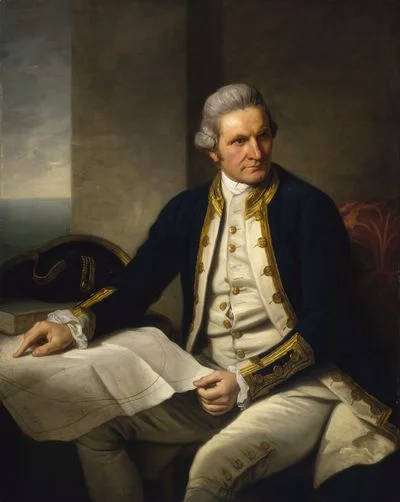
Mapped Pacific, Australia, New Zealand: Captain Cook charted the unknown.
Conversation Starters
Life Journey
James Cook was born into a humble farming family in a small village in northern England. His father was a Scottish farm laborer, and young James showed early signs of intelligence that would eventually lead him far beyond the fields of his birth.
Cook became an apprentice to a grocer in the fishing village of Staithes. Working near the sea sparked his lifelong fascination with maritime life, and after only eighteen months, he abandoned shopkeeping to pursue his calling on the water.
Cook began his maritime career as a merchant navy apprentice under the Walker family of Whitby, learning seamanship aboard coal ships in the brutal North Sea trade. He studied mathematics, navigation, and astronomy in his spare time, mastering the skills that would make him legendary.
Though offered command of a merchant vessel, Cook shocked his employers by enlisting as an able seaman in the Royal Navy at the start of the Seven Years' War. He chose to start at the bottom of a service that offered advancement by merit, a decision that would shape world history.
Cook passed his master's examination, qualifying him to navigate and handle a ship in the King's Navy. His exceptional abilities were already attracting notice from superior officers who would later champion his career.
During the siege of Louisbourg and Quebec, Cook made remarkably accurate charts of the St. Lawrence River, enabling the British fleet to navigate treacherous waters. His surveying skills proved crucial to General Wolfe's capture of Quebec, helping win Canada for Britain.
Cook married Elizabeth Batts of Barking. Despite his long absences at sea, they maintained a devoted marriage until his death. Elizabeth would bear six children, though tragically none survived to have children of their own.
Cook spent five seasons meticulously surveying the coastline of Newfoundland, producing charts of such unprecedented accuracy that they remained in use for over a century. His work established his reputation as the finest maritime surveyor of his age.
The Royal Society and Admiralty selected Cook to command HMS Endeavour on a scientific expedition to Tahiti to observe the transit of Venus. His secret orders also directed him to search for the theoretical southern continent, Terra Australis, launching the first of his three great voyages.
Cook successfully observed the transit of Venus from Tahiti, the expedition's official purpose. He established excellent relations with the Tahitians and gathered invaluable scientific observations before sailing into the unknown Pacific in search of new lands.
Cook became the first European to circumnavigate and chart New Zealand, discovering it was two main islands rather than part of a southern continent. His detailed maps and descriptions opened the Pacific to European knowledge and eventual colonization.
Cook charted the entire eastern coastline of Australia, claiming it for Britain as New South Wales. After nearly losing the Endeavour on the Great Barrier Reef, he completed the most comprehensive survey of unknown coastline ever achieved in a single voyage.
Cook set sail on HMS Resolution to definitively prove or disprove the existence of Terra Australis. This expedition would take him farther south than any human had ever traveled, into waters no ship had ever entered.
Cook became the first explorer known to cross the Antarctic Circle, reaching 71ยฐ10' south latitude. Though ice prevented him from sighting Antarctica itself, he proved that any southern continent must be a frozen wasteland, not the rich habitable land theorists had imagined.
During his second voyage, Cook discovered or made first European contact with numerous Pacific islands including New Caledonia, Norfolk Island, and the South Sandwich Islands. He also revisited and better charted many islands from his first voyage.
Cook embarked on his final voyage aboard HMS Resolution, tasked with finding the Northwest Passage from the Pacific side. This expedition would take him to the Hawaiian Islands and the Arctic, expanding European knowledge of the Pacific to its farthest limits.
Cook became the first European to reach the Hawaiian Islands, which he named the Sandwich Islands. The Hawaiians initially received him with great reverence, possibly mistaking him for the god Lono during their Makahiki festival.
After returning to Hawaii to repair a damaged mast, tensions with native Hawaiians escalated. During a confrontation over a stolen boat, Cook was killed on the beach at Kealakekua Bay. The greatest explorer of his age died at fifty, having charted more of the Earth's surface than any person before or since.