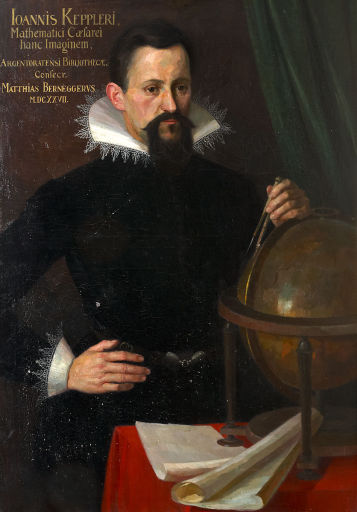
Quick Facts
Brilliant astronomer who uncovered planetary motion laws, blending mathematics, theology, and relentless observation to explain the heavens.
Conversation Starters
Life Journey
Johannes Kepler was born to Heinrich Kepler and Katharina Guldenmann in Weil der Stadt, a small imperial town in the Holy Roman Empire. Frail health and a turbulent family life shaped his discipline, while early schooling revealed exceptional mathematical talent.
As a child in Württemberg, he was taken to see the Great Comet of 1577, a widely discussed phenomenon that challenged older Aristotelian ideas. The spectacle, along with later eclipses, helped spark a lifelong fascination with the physical reality of the heavens.
Kepler entered a rigorous Lutheran educational track at the monastery school in Adelberg, where Latin, logic, and mathematics were central. This pipeline aimed to produce clergy, but it also trained him in the precise reasoning that later served his astronomy.
At the University of Tübingen, Kepler studied theology and mathematics and learned advanced astronomy from Michael Maestlin. Maestlin privately taught Copernican heliocentrism, and Kepler’s aptitude convinced him that a Sun-centered cosmos better fit geometrical elegance.
Kepler accepted a post at the Lutheran school in Graz as mathematics teacher and provincial mathematician for Styria. He produced calendars and astrological forecasts, work expected of mathematicians then, while quietly pursuing deeper cosmological questions.
He published 'Mysterium Cosmographicum,' proposing that the spacing of the known planets reflected nested Platonic solids and divine geometry. Though the model was wrong, it was a bold public defense of Copernican heliocentrism that introduced him to Europe’s scientific network.
Kepler married Barbara Müller, a widow, as religious conflict intensified between Protestant and Catholic authorities in Inner Austria. Family responsibilities and political pressure made stable research difficult, yet he continued writing and corresponding with leading astronomers.
Invited by Tycho Brahe, he traveled to work with Tycho’s precise planetary measurements, then the best in Europe. Their collaboration was uneasy, but access to the Mars data would become the crucial empirical foundation for Kepler’s new planetary theory.
After Tycho Brahe died, Emperor Rudolf II appointed Kepler as Imperial Mathematician, giving him official responsibility for astronomical tables and court work. He inherited Tycho’s observational legacy and the obligation to turn raw measurements into predictive astronomy.
Kepler closely studied the brilliant 'new star' of 1604, later known as Kepler’s Supernova, visible from Prague. By documenting its behavior and arguing it lay among the fixed stars, he helped undermine claims that the heavens were unchanging and perfect.
Working obsessively with Tycho’s Mars observations, Kepler concluded that circular orbits could not fit the data to the required precision. He found that Mars follows an ellipse with the Sun at one focus and that planets sweep equal areas in equal times.
In 'Astronomia Nova,' Kepler presented the first two laws of planetary motion, grounded in Tycho Brahe’s measurements and a physical view of celestial causes. The book’s careful arguments linked geometry to observation and marked a turning point toward modern celestial mechanics.
Kepler’s 'Dioptrice' explained how lenses form images and described the optics behind the Keplerian telescope design. His analysis connected astronomy to the physiology of vision, providing tools and concepts that later instrument makers and astronomers widely adopted.
Political instability and the growing crisis that led toward the Thirty Years’ War forced Kepler to relocate to Linz. There he served as provincial mathematician for Upper Austria while continuing long-term work on planetary tables and mathematical writings.
Katharina Kepler was accused of witchcraft in a climate of fear and sectarian violence, and Johannes undertook a meticulous legal defense. He drafted arguments, managed petitions, and navigated local courts, helping secure her eventual release after prolonged imprisonment.
In 'Harmonices Mundi,' Kepler pursued the idea that the cosmos expresses mathematical harmony, linking music, geometry, and astronomy. He announced the third law relating orbital periods to distances from the Sun, a simple proportionality with immense predictive power.
Kepler published the 'Rudolphine Tables,' a major computational achievement that produced far more accurate planetary positions than earlier tables. Built on Tycho Brahe’s data and Kepler’s laws, they became essential for navigation, calendrics, and astronomical prediction across Europe.
Kepler traveled to Regensburg to negotiate long-delayed payments and secure support during the hardships of the Thirty Years’ War. He fell ill and died there, leaving behind a body of work that later enabled Isaac Newton to unify celestial and terrestrial physics.