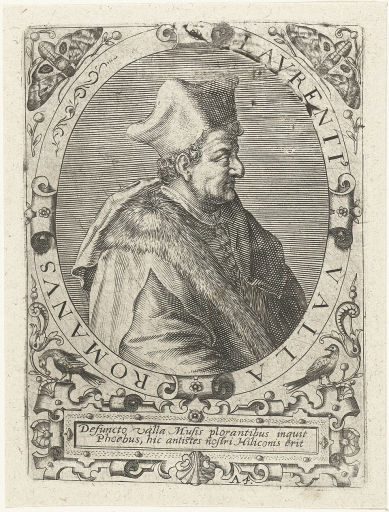
Quick Facts
A razor-sharp Renaissance humanist who exposed forged documents and reshaped Latin scholarship through bold, skeptical philology.
Conversation Starters
Life Journey
Born in Rome during the early Italian Renaissance, he grew up amid papal bureaucracy and classical learning. Family connections in the Curia exposed him early to Latin letters and ambitious scholarly careers.
As a teenager he studied rhetoric, grammar, and logic with prominent Roman humanists tied to the papal court. Intensive imitation of Cicero and Quintilian shaped his conviction that style and truth were linked.
He advanced in higher studies and began circulating arguments about language, rhetoric, and moral philosophy. His sharp critiques of scholastic habits made him noticed as both brilliant and combative in learned circles.
He attempted to secure an official Curial post, hoping Rome would reward his Latin expertise. Political rivalries and suspicion of his outspoken criticism pushed him to seek opportunities beyond the papal administration.
He took up teaching, using classical authors as models for argument and moral clarity. In lectures and disputations he developed the philological habit of testing authorities by vocabulary, idiom, and historical context.
He moved to Naples and joined the circle of Alfonso V of Aragon, where humanists competed for patronage and prestige. The court’s political needs encouraged him to apply textual criticism to claims of legitimacy.
He began shaping what became the 'Elegantiae linguae Latinae,' a guide to restoring classical Latin usage. By treating grammar as historical evidence, he turned style into a tool for intellectual reform across Europe.
In 'De falso credita et ementita Constantini Donatione,' he argued the document’s Latin and institutions were centuries too late for Constantine. His philology undermined a cornerstone of papal temporal claims with scholarly precision.
He composed 'De voluptate,' staging debates that weighed Epicurean arguments against Stoic and Christian ethics. The dialogue form let him test ideas sharply while provoking critics who feared humanism’s moral implications.
Through works such as 'Repastinatio dialectice et philosophie,' he attacked technical scholastic language as confused and historically careless. He insisted that clear Latin and attention to usage could correct philosophical mistakes.
His fearless criticism of accepted authorities drew complaints that reached ecclesiastical officials. Protected by Alfonso V’s influence, he navigated accusations while continuing to argue that philology could serve, not destroy, Christian truth.
After Nicholas V’s election, Rome recruited humanist scholars to strengthen the papacy’s cultural authority. Valla returned and found space for critical learning within a program of translation, libraries, and improved Latin letters.
He gained a role as apostolic secretary, drafting and refining official Latin while advising on style and sources. The position signaled papal confidence that classical eloquence could enhance governance and diplomacy.
He compared the Latin Vulgate with Greek readings and older linguistic evidence, marking errors and misleading renderings. Rather than mere pedantry, he framed correction as a return to the earliest, most reliable Christian texts.
His 'Annotationes' on the New Testament’s Latin wording spread among scholars interested in reforming biblical study. The work anticipated later textual criticism by treating sacred language as historically situated and corrigible.
He continued revising 'Elegantiae,' turning it into a widely consulted reference for prose style and usage. Teachers and secretaries used it to standardize Latin across courts and universities as humanism expanded northward.
With Nicholas V gone and new priorities emerging under later pontificates, he maintained influence through unrivaled command of Latin and argument. His career showed how scholarship could survive by adapting to Rome’s changing factions.
He died in Rome having transformed humanist scholarship into a method for testing authority with historical language evidence. Later figures, including Erasmus, drew on his example when applying philology to church tradition and scripture.