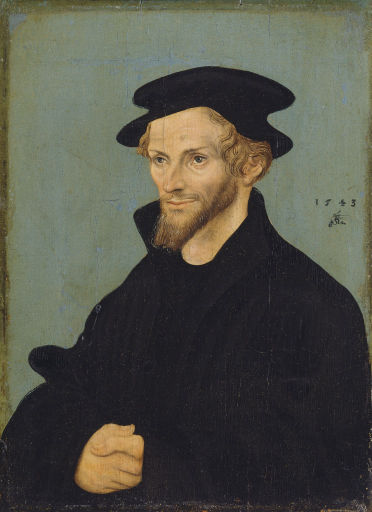
Quick Facts
Humanist scholar who systematized Protestant theology, forged educational reforms, and steadied the Reformation through diplomacy and clear teaching.
Conversation Starters
Life Journey
Born Philipp Schwartzerdt into a learned artisan family, he grew up amid the late medieval schools of the Holy Roman Empire. Early exposure to Latin study set the foundation for his later Renaissance humanism and reform work.
After family losses, he moved to Pforzheim and studied at the Latin school connected to humanist networks. His great-uncle Johannes Reuchlin encouraged Greek learning and coined the Greek surname “Melanchthon,” meaning “black earth.”
He entered the University of Heidelberg unusually young and immersed himself in grammar, logic, and classical texts. The university’s scholastic routines sharpened his taste for rigorous method, even as humanism drew him toward Greek and rhetoric.
At Tuebingen he joined a vibrant humanist community and expanded advanced Greek study for theological reading. He edited and taught classical authors while forming friendships with scholars who valued philology as a tool for church renewal.
He completed the Master of Arts at Tuebingen and began lecturing on rhetoric, dialectic, and classical literature. His lectures made him known as a gifted organizer of knowledge, able to translate scholarship into teachable structures.
Invited by Elector Frederick the Wise, he took a chair at the University of Wittenberg and delivered an influential inaugural oration on reforming learning. There he met Martin Luther and became a key scholarly partner in the early Reformation.
During the Leipzig Debate, Luther and Johann Eck clashed over authority and doctrine, and Melanchthon followed the controversy closely. His command of Greek and patristic sources strengthened Wittenberg’s intellectual case for reforming church teaching.
He published the first edition of “Loci Communes,” organizing evangelical doctrine into clear thematic topics drawn from Paul’s letters. The work gave the Reformation a systematic framework and quickly became a standard textbook across Protestant schools.
As changes accelerated in Wittenberg, he worked with Luther to steady the reform movement and keep preaching and worship orderly. His strength lay in drafting educational plans and advising colleagues, balancing zeal with institutional continuity.
He married Katharina Krapp, linking his academic life to the civic society of Wittenberg. Their home became a center for students and visiting pastors, reflecting his belief that learned, disciplined households supported church and school reform.
Commissioned by Electoral Saxony, he helped conduct church and school visitations to assess pastors, teaching, and catechesis. The surveys exposed widespread ignorance and drove him to write practical guidelines for clergy training and curricula.
At Marburg, Luther and Huldrych Zwingli tried to unify Protestants but divided sharply over Christ’s presence in the Lord’s Supper. Melanchthon participated with caution, seeking concord while recognizing how doctrine and politics shaped alliances.
At the Imperial Diet, he drafted the Augsburg Confession as a measured statement of evangelical faith for Emperor Charles V. Written in careful Latin and German, it aimed to show continuity with the ancient church while defending reform against abuse charges.
After Catholic theologians issued a rebuttal, he composed the Apology of the Augsburg Confession to defend key teachings like justification and the sacraments. The document strengthened Lutheran identity and trained pastors to argue from Scripture and tradition.
He traveled to the Regensburg Colloquy to negotiate religious peace with Catholic representatives under imperial pressure. While some agreement emerged on justification language, deeper disputes over authority and worship remained, revealing the limits of theological compromise.
When Luther died, Melanchthon delivered funeral reflections and faced the task of guiding Wittenberg’s theological legacy. Without Luther’s political weight, he increasingly relied on persuasion and scholarship to hold Protestant alliances together.
After imperial victory, Charles V imposed the Augsburg Interim, pressuring Protestants to restore many Catholic practices. Melanchthon’s attempts to preserve core doctrine while yielding on some ceremonies sparked fierce disputes, later called the Adiaphoristic Controversy.
The Peace of Augsburg recognized legal coexistence for Lutheran territories within the Empire under the principle of territorial choice. Though not his personal achievement alone, it confirmed the durable institutional future of the movement he helped systematize.
He died after decades of teaching, writing, and negotiating for church reform and educational renewal. Buried at the Castle Church in Wittenberg near Luther, he was remembered as “Praeceptor Germaniae,” the teacher who shaped Protestant learning.