Quick Facts
Ireland's patron saint: Drove out snakes, brought Christianity.
Conversation Starters
Life Journey
Patrick was born to Calpurnius, a Roman-British deacon and minor official, and his wife Conchessa. The family lived in a villa near the western coast of Britain, possibly in modern Wales or northern England. Despite his father's position as a deacon, young Patrick later admitted he had little interest in religion during his comfortable youth.
Irish pirates raided Patrick's family estate, capturing him along with thousands of others. He was taken to Ireland and sold into slavery to a chieftain named Milchu in County Antrim. Separated from his family and homeland, the teenage Patrick was forced to tend sheep on the bleak hillsides of northeastern Ireland.
Alone on the windswept hills guarding flocks, Patrick turned to prayer. He later wrote that he prayed up to a hundred times daily and rose before dawn to pray in snow, frost, and rain. This profound spiritual transformation during his six years of slavery would shape his entire life and mission.
After six years of captivity, Patrick received a dream in which a voice told him, 'Your ship is ready.' He escaped from his master and traveled two hundred miles across unfamiliar territory to find a ship preparing to sail. After initial refusal, the sailors agreed to take him aboard.
Patrick's ship landed after three days, possibly in Gaul. The travelers wandered through a wilderness for twenty-eight days, nearly starving until Patrick prayed and a herd of wild pigs appeared. Eventually he returned to Britain and his overjoyed family, who begged him never to leave them again.
In a powerful dream, Patrick saw a man named Victoricus bearing countless letters from Ireland. As he read one titled 'The Voice of the Irish,' he heard the voices of those beside the Western Sea crying, 'We beg you, holy youth, to come and walk among us.' He awoke determined to return as a missionary.
Patrick entered religious training, possibly at Auxerre in Gaul under Bishop Germanus. He studied Scripture, theology, and Latin literature for many years. His limited classical education compared to contemporaries would later cause him embarrassment, but his spiritual depth and sincerity were unquestionable.
After years of rigorous study and spiritual preparation, Patrick was ordained to the priesthood. He continued to seek permission to return to Ireland as a missionary, but church authorities were initially reluctant to send him to such a remote and dangerous pagan land.
Patrick was consecrated as a bishop and finally authorized to lead the mission to Ireland. He landed near Strangford Lough in Ulster, returning to the land of his captivity not as a slave but as Christ's ambassador. He brought a small group of companions to begin the conversion of the Irish people.
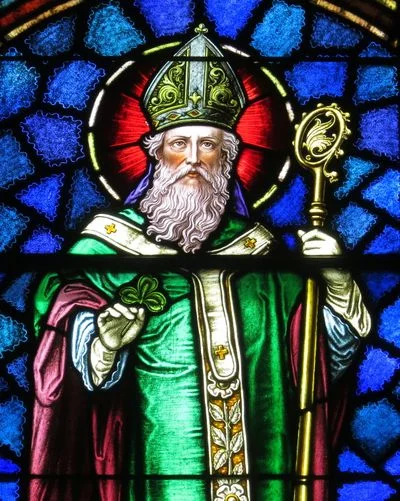
During the pagan festival of Beltane, Patrick lit a paschal fire on the Hill of Slane, visible from the High King's seat at Tara. When summoned to explain this defiance of druidic law, Patrick boldly preached Christianity to King Lóegaire. Using the shamrock to explain the Trinity, he won permission to preach throughout Ireland.
Patrick established his principal church at Armagh, which would become the ecclesiastical capital of Ireland. He negotiated with local kings for land and built churches, monasteries, and schools throughout the country. Armagh remains the primatial see of both Catholic and Anglican churches in Ireland today.
Patrick baptized King Óengus of Munster at the Rock of Cashel. According to legend, during the ceremony Patrick accidentally drove his crozier through the king's foot, but Óengus never complained, thinking it part of the ritual. This conversion brought southern Ireland firmly into the Christian fold.
Patrick spent forty days fasting and praying on the mountain now called Croagh Patrick in County Mayo. According to tradition, he drove all the snakes from Ireland during this retreat—a legend symbolizing his banishment of pagan worship. The mountain remains a major pilgrimage site.
Patrick founded monastic schools throughout Ireland that combined religious instruction with learning. These institutions would preserve classical knowledge through the Dark Ages and send missionaries across Europe. He ordained hundreds of priests and consecrated bishops to continue his work.
Patrick faced serious accusations from church leaders in Britain, possibly regarding some youthful sin he had confessed to a friend. Though the charges wounded him deeply, he defended himself vigorously while accepting his own unworthiness. This crisis prompted him to write his Confessio.
Patrick composed his spiritual autobiography, the Confessio, defending his mission and declaring his faith. Written in simple but passionate Latin, it reveals his profound humility, his gratitude for God's grace, and his burning love for the Irish people. It remains one of the most moving documents of early Christianity.
Patrick wrote his fierce Letter to Coroticus, a British ruler whose soldiers had killed and enslaved newly baptized Irish Christians. Patrick excommunicated Coroticus and demanded the return of the captives. This letter reveals his identification with the Irish and his courage in confronting injustice.
Patrick died on March 17, traditionally in 461, at Saul in County Down—the site of his first church in Ireland. He was buried nearby at Downpatrick. Though he died owning nothing, having given everything away, he left behind a Christian Ireland and a legacy that would spread learning and faith across Europe.