Quick Facts
Father of Numbers": Pythagoras, theorem maker, music mystic, soul shifter.
Conversation Starters
Life Journey
Pythagoras was born on the island of Samos in the eastern Aegean Sea. His father Mnesarchus was a merchant who traveled widely. According to legend, the Pythia at Delphi prophesied that Pythagoras would surpass all other men in wisdom and contribute immensely to humanity.
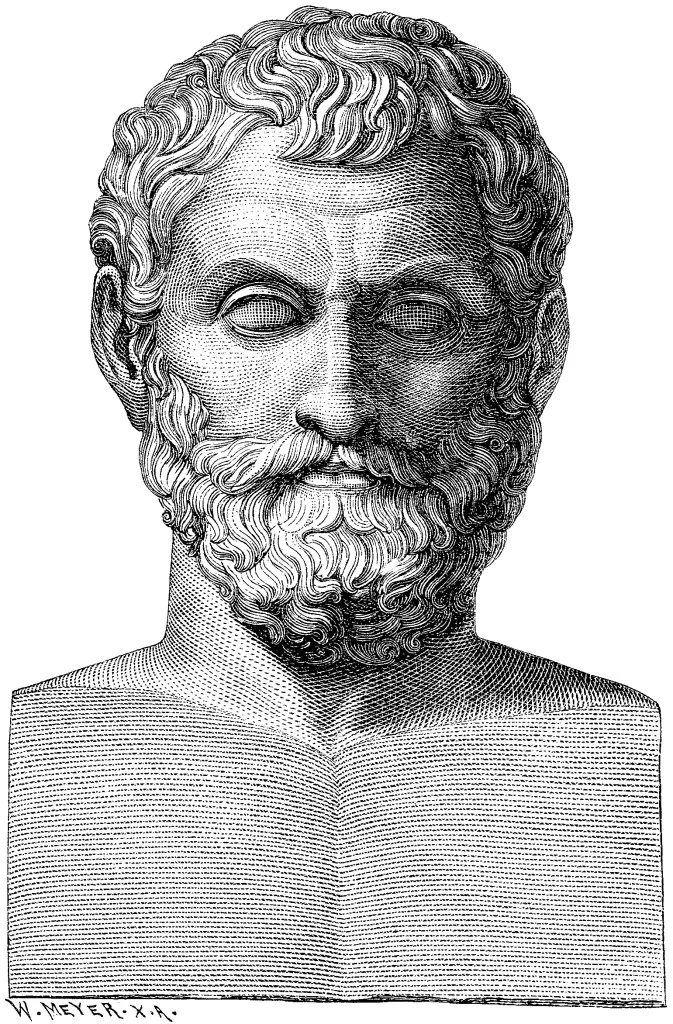
Pythagoras traveled to Miletus to study with Thales, the father of Greek philosophy, and his student Anaximander. Though Thales was elderly, he recognized Pythagoras's exceptional talent and advised him to travel to Egypt to study with the priests there, setting the course of his intellectual development.
Following Thales's advice, Pythagoras journeyed to Egypt, where he spent over twenty years studying with priests at various temples, including Memphis, Thebes, and Heliopolis. He learned geometry, astronomy, and religious mysteries that would profoundly influence his later teachings.
Pythagoras was initiated into the sacred mysteries of the Egyptian priests after demonstrating his dedication and spiritual purity. These initiations introduced him to esoteric knowledge about the soul's immortality and the mathematical principles underlying the universe.
After being captured during the Persian conquest of Egypt, Pythagoras was taken to Babylon, where he spent twelve years studying with the Magi and Chaldean priests. Here he deepened his knowledge of astronomy, numerology, and the mystical properties of numbers that became central to his philosophy.
After thirty years abroad, Pythagoras returned to Samos, now ruled by the tyrant Polycrates. Finding the political climate unsuitable for his teachings and his homeland resistant to his ideas, he lived briefly in a cave outside the city while deciding where to establish his school.
Pythagoras emigrated to Croton, a prosperous Greek colony in southern Italy. He was welcomed by the intellectual community there and quickly attracted followers. His arrival marked the beginning of the most productive period of his life and the establishment of his famous school.
Pythagoras established his philosophical school, which was both an academy for studying mathematics, music, and astronomy, and a religious brotherhood with strict rules of conduct, secrecy, and communal living. Members underwent five years of silence before being admitted to his inner circle.
Pythagoras married Theano, one of his students and daughter of his host Brontinus. Theano became a philosopher in her own right and helped lead the Pythagorean community after his death. They had several children who also became prominent Pythagoreans.
Though the relationship between the sides of a right triangle was known earlier, Pythagoras provided the first rigorous mathematical proof that in a right triangle, the square of the hypotenuse equals the sum of squares of the other two sides. This became the most famous theorem in mathematics.
Pythagoras discovered that musical intervals could be expressed as mathematical ratios. Using a monochord, he demonstrated that pleasing harmonies correspond to simple numerical proportions—the octave (2:1), the fifth (3:2), and the fourth (4:3). This linked mathematics to aesthetics and the cosmos.
Pythagoras elaborated his doctrine of metempsychosis, the transmigration of souls. He taught that the soul was immortal and passed through successive reincarnations in human and animal forms. This belief led to vegetarianism and strict ethical rules among his followers to purify the soul.
The Pythagorean brotherhood gained significant political influence in Croton and other cities of Magna Graecia. Members held key political positions and promoted an aristocratic government based on wisdom and virtue. This political involvement would eventually lead to violent opposition.
Cylon, a wealthy aristocrat who had been rejected from the Pythagorean community, began organizing opposition against the brotherhood. He accused them of being a secretive and elitist sect that threatened democratic principles. This conflict would culminate in violent persecution.
During a violent uprising against the Pythagoreans, mobs attacked their meeting houses and murdered many members. Pythagoras fled to Metapontum, where he died shortly after—some say from starvation, refusing to eat beans (forbidden by his doctrines), others say from grief. His teachings survived through his devoted followers.