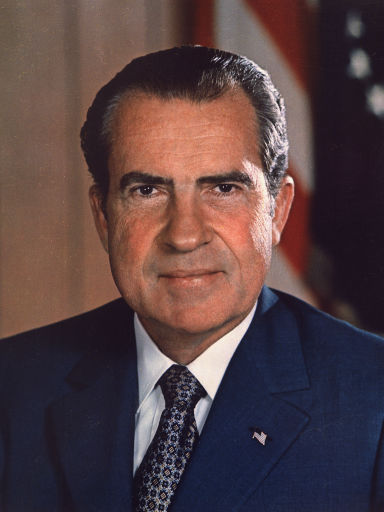
Quick Facts
A shrewd, intensely driven American president whose foreign-policy breakthroughs were overshadowed by the Watergate scandal and resignation.
Conversation Starters
Life Journey
Born to Frank and Hannah Nixon in the small oil-town of Yorba Linda. Raised in a strict Quaker-influenced household, he absorbed ideas of discipline, work, and moral scrutiny early.
The Nixons moved to Whittier, where they ran a grocery and gas station. Working long hours behind the counter shaped Nixon's self-image as an outsider competing against privilege.
He completed his studies at Whittier College, building a reputation for ambition in debate and student politics. Winning a scholarship, he entered Duke University School of Law during the Depression era.
After graduating from Duke Law, he joined the firm Wingert and Bewley in Whittier. His meticulous preparation and courtroom intensity hinted at the political campaigner he would soon become.
Nixon married Pat Ryan after a persistent courtship that began in local theater. Their partnership became central to his public image, as Pat campaigned beside him through repeated high-stakes races.
He entered the Navy and served as a supply officer in the Pacific theater. The wartime experience broadened his national network and burnished his credentials as the country shifted into postwar politics.
Running as a Republican, he defeated incumbent Jerry Voorhis in a hard-edged campaign shaped by early Cold War anxieties. The victory launched him into national attention and anti-communist politics.
As a member of the House Un-American Activities Committee, he pursued allegations against former State Department official Alger Hiss. The case made Nixon a household name and polarized American politics.
He defeated Helen Gahagan Douglas in a fiercely negative campaign during heightened Red Scare rhetoric. The win strengthened his standing with national Republicans and positioned him for executive office.
Chosen to balance Eisenhower's ticket, Nixon faced accusations about a private political fund. His televised "Checkers" speech appealed directly to voters and helped keep him on the 1952 Republican ticket.
At the American National Exhibition, Nixon debated Soviet leader Nikita Khrushchev over consumer life and ideology. The encounter, broadcast widely, showcased his combative style and Cold War fluency.
He narrowly lost to Senator John F. Kennedy in a close and contested election shaped by Cold War fears. The first televised debates highlighted his vulnerability to image and media dynamics.
After losing to Governor Pat Brown, Nixon delivered a bitter press conference declaring the media would not have him "to kick around" anymore. He moved toward private law and planned a comeback quietly.
He won the presidency amid Vietnam War turmoil, urban unrest, and a fractured Democratic Party. Promising "peace with honor" and "law and order," he assembled a disciplined, loyal White House team.
Nixon signed measures that reorganized federal environmental enforcement into the Environmental Protection Agency. The move reflected rising public concern after pollution crises and the first Earth Day in 1970.
He visited Beijing, meeting Mao Zedong and Premier Zhou Enlai to reshape the Cold War balance. The trip opened diplomatic channels after decades of hostility and altered U.S. strategy toward the Soviet Union.
Burglars linked to Nixon's campaign were arrested at the Democratic National Committee offices in the Watergate complex. Investigations by journalists and Congress uncovered a cover-up that reached the Oval Office.
After the Supreme Court ordered release of White House tapes, support in Congress collapsed. Facing impeachment, he resigned and transferred power to Gerald Ford, the first U.S. president to do so.
Nixon died in New York City following complications from a stroke, with Pat Nixon already deceased. A state funeral drew U.S. and foreign leaders, reflecting both his achievements and enduring controversy.