Quick Facts
A quietly radical Japanese potter who elevated everyday folk ceramics into internationally admired art through Mingei ideals.
Conversation Starters
Life Journey
Shoji Hamada was born in Tokyo, Japan, into a family connected to commerce and urban life. Growing up in the Meiji era, he witnessed rapid industrialization that later deepened his respect for handmade craft traditions.
He enrolled at Tokyo Industrial College, focusing on ceramic technology and design at a time when Japan promoted modern industry. The school’s emphasis on materials and kilns gave him technical fluency that supported later rustic aesthetics.
After completing his studies, Hamada moved into professional ceramic production and design work. Early employment exposed him to the tensions between factory standardization and the expressive potential of traditional handcraft.
Hamada met Bernard Leach in Japan and found a kindred spirit interested in reviving ethical, handmade pottery. Through Leach’s network, he encountered cross-cultural ideas linking Japanese folk craft with the British Arts and Crafts tradition.
He traveled with Bernard Leach to St Ives, Cornwall, to found the Leach Pottery, a landmark studio for modern craft. Working beside Leach, he shared Japanese kiln knowledge while absorbing British studio pottery practices and markets.
At St Ives he participated in building and firing kilns, testing slips, ash glazes, and iron-rich decoration on functional forms. These experiments helped define the restrained surfaces later associated with Mashiko and the Mingei aesthetic.
Hamada returned to Japan and began searching for a place where traditional materials, fuel, and local skills still thrived. The Great Kanto Earthquake that year underscored impermanence and reinforced his commitment to durable, everyday wares.
He chose Mashiko, Tochigi Prefecture, known for humble utilitarian pottery, and established his studio there. By building and firing kilns with local help, he rooted his practice in regional clay, ash, and community labor traditions.
Hamada grew close to Yanagi Soetsu, the philosopher who articulated Mingei as the beauty of anonymous, useful craft. Their discussions connected Hamada’s studio practice to a wider cultural critique of industrial modernity in Japan.
As demand grew, he organized workshop routines that still privileged throwing, brushing, and quick, confident decoration by hand. He promoted simple forms—bottles, bowls, and jars—meant for daily use rather than elite display.
He supported the establishment of the Nihon Mingeikan in Komaba, founded by Yanagi Soetsu to preserve folk craft. The museum framed Hamada’s pottery within a broader movement that valued regional artisans and vernacular design.
After World War II, Hamada resumed intensive kiln work as Japan reconstructed its cultural identity and economy. His emphasis on honest materials and functional beauty resonated strongly in a society seeking stability and renewal.
By the early 1950s, his work circulated widely through exhibitions and collectors, influencing studio potters abroad. His friendship with Bernard Leach helped create a bridge between Japanese folk craft and Western modern craft education.
The Japanese government designated Hamada a Living National Treasure (Ningen Kokuho), recognizing exceptional mastery of traditional craft. The honor elevated Mashiko pottery and made him a public symbol of cultural continuity in modern Japan.
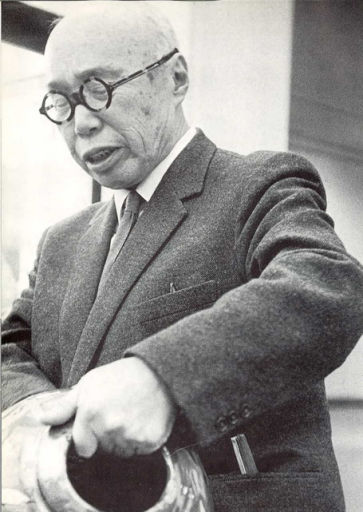
At his Mashiko compound he demonstrated throwing, slip trailing, and brushwork to students and visiting artists from Japan and abroad. His teaching emphasized rhythm, speed, and acceptance of kiln chance rather than meticulous perfection.
He traveled for major demonstrations and exhibitions that introduced many Western audiences to Mingei values firsthand. These tours strengthened postwar cultural exchange and reinforced the idea that utilitarian pottery could be serious art.
In his later years, Hamada consolidated tools, kilns, and archives so the Mashiko site could communicate his methods and philosophy. The workshop environment preserved the interplay of local materials, disciplined routine, and communal making.
Hamada died in Mashiko, leaving behind vessels that made everyday use inseparable from beauty and ethics. His influence endured through the Mingei movement, the Leach Pottery legacy, and generations of studio potters worldwide.