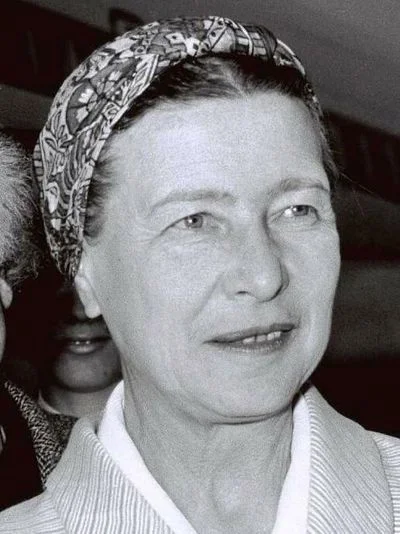
Quick Facts
One is not born, but becomes a woman." Existentialist feminist.
Conversation Starters
Life Journey
Simone de Beauvoir was born into a bourgeois Parisian family. Her father Georges was a legal secretary with literary ambitions, while her mother Françoise was a devout Catholic. The family's declining fortune after World War I would profoundly shape her rejection of bourgeois values.
Beauvoir met Élisabeth Lacoin, nicknamed 'Zaza,' at the Cours Désir Catholic school. Their intense friendship became central to Beauvoir's emotional development, and Zaza's tragic death in 1929 from encephalitis—which Beauvoir blamed on her repressive bourgeois upbringing—haunted her for life.
After years of devout Catholicism instilled by her mother, Beauvoir experienced a crisis of faith and became an atheist. This intellectual liberation freed her to question all received ideas and conventional morality, setting the stage for her existentialist philosophy.
Beauvoir enrolled at the Sorbonne to study philosophy, mathematics, and literature. Determined to achieve intellectual and financial independence through teaching, she excelled academically and formed lasting friendships with fellow philosophy students.
While preparing for the agrégation exam, Beauvoir met Jean-Paul Sartre through mutual friends. Their intellectual connection was immediate and profound. She passed the agrégation at age 21—the youngest person ever—finishing second only to Sartre, beginning their legendary fifty-year partnership.
Beauvoir began teaching philosophy at a lycée in Marseille, far from Sartre in Paris. Despite the painful separation, she embraced her independence, explored the Mediterranean region, and began seriously writing fiction. She later moved to Rouen, then Paris.
Beauvoir published her first novel, exploring jealousy and consciousness through a fictionalized account of her relationship with Sartre and Olga Kosakiewicz. Written during the German occupation, it established her as a serious literary voice and explored themes of freedom and bad faith.
Beauvoir became a founding editor of Les Temps Modernes, the influential existentialist journal created with Sartre. The journal became a platform for committed literature and political engagement, addressing colonialism, communism, and social justice throughout the Cold War era.
During a lecture tour of America, Beauvoir met Chicago writer Nelson Algren. Their passionate love affair, conducted across the Atlantic, lasted years and profoundly affected both. Beauvoir later called Algren the only truly passionate love of her life.
Beauvoir published her groundbreaking analysis of women's oppression, arguing 'One is not born, but rather becomes, a woman.' The Vatican placed it on its Index of Forbidden Books, but it became the foundational text of second-wave feminism, transforming how women understood their situation.
Beauvoir won France's most prestigious literary prize for 'The Mandarins,' a sweeping novel depicting post-war Parisian intellectuals grappling with political commitment. The book drew heavily on her relationships with Sartre and Algren and examined the dilemmas of engaged intellectuals.
Beauvoir published the first volume of her autobiography, brilliantly chronicling her bourgeois childhood, intellectual awakening, and friendship with Zaza. The memoir's honest examination of a woman's formation became a model for feminist autobiography.
Beauvoir signed the 'Declaration on the Right to Insubordination in the Algerian War,' supporting conscientious objectors and Algerian independence. The manifesto brought death threats and police harassment but demonstrated her commitment to anti-colonial struggle.
Beauvoir published her searing memoir about her mother's death from cancer, examining their complicated relationship and the medical establishment's treatment of the dying. The work pioneered honest discussion of mortality and influenced medical ethics discourse.
Beauvoir actively supported the student and worker uprising that paralyzed France. She marched, signed manifestos, and defended arrested protesters. The events radicalized her further, pushing her toward more direct feminist activism.
Beauvoir became actively involved in feminist organizing, co-founding the Mouvement de Libération des Femmes (MLF). In 1971, she signed the 'Manifesto of the 343'—women declaring they had had illegal abortions—risking prosecution to advance reproductive rights.
Jean-Paul Sartre died after years of declining health. Beauvoir had nursed him through his final years and wrote 'Adieux: A Farewell to Sartre,' a controversial but moving account of his last decade. Fifty thousand people followed his funeral procession through Paris.
Simone de Beauvoir died of pneumonia in Paris and was buried beside Sartre in Montparnasse Cemetery. Her legacy as the mother of second-wave feminism endures, and 'The Second Sex' remains essential reading for understanding gender, freedom, and women's liberation.