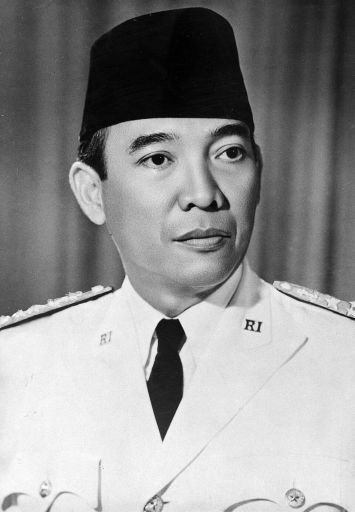
Quick Facts
Charismatic Indonesian nationalist who fused anti-colonial politics, mass oratory, and ideology to found a new republic.
Conversation Starters
Life Journey
Born to Raden Soekemi Sosrodihardjo, a Javanese teacher, and Ida Ayu Nyoman Rai, a Balinese Hindu mother. He was renamed Sukarno in childhood, a change linked to family hopes for better health and fortune.
He lived in the household of Sarekat Islam leader H.O.S. Tjokroaminoto, absorbing modern politics and debating future activists. The Surabaya environment sharpened his gift for public speaking and coalition-building across ideologies.
He enrolled at the Technische Hoogeschool (later ITB), studying civil engineering while joining nationalist circles. Bandung’s student milieu helped him blend modernist ideas, anti-colonialism, and mass politics into a coherent program.
After earning his engineering credential, he worked briefly in architecture and construction while prioritizing politics. He used professional networks and student contacts to build platforms for anti-Dutch mobilization and propaganda.
Sukarno helped establish the Partai Nasional Indonesia (PNI) to push openly for independence rather than gradual reform. His speeches framed colonialism as a moral and economic crisis, attracting workers, youth, and the urban middle class.
The colonial government detained him amid crackdowns on the PNI and other radicals. His courtroom defense turned into a political manifesto, using legal proceedings to publicize independence demands to a wider audience.
In his trial he presented 'Indonesia Accuses!' (Indonesia Menggugat), attacking Dutch exploitation and racial hierarchy. The speech elevated him as a national symbol and helped consolidate nationalist narratives across the archipelago.
After repeated surveillance and detention, the Dutch exiled him to remote postings to weaken the nationalist movement. Cut off from major cities, he continued writing and mentoring sympathizers while polishing his ideological message.
Colonial authorities relocated him to Bengkulu, where he built community ties and remained politically active despite restrictions. The period deepened his sense of Indonesia’s cultural diversity and the need for a unifying national philosophy.
When Japan displaced the Dutch, Sukarno cooperated with occupation institutions to mobilize labor and nationalist organizations. He sought to turn wartime upheaval into a pathway to independence, a choice that later drew controversy.
In debates over Indonesia’s future, he promoted Pancasila as five guiding principles to bridge religion, nationalism, and social justice. The concept aimed to hold together a plural society spanning Java, Sumatra, Sulawesi, and beyond.
On 17 August 1945, Sukarno and Mohammad Hatta read the Proclamation of Independence as Japan surrendered. The moment launched the Indonesian Revolution, forcing Dutch attempts at restoration into a protracted conflict and diplomacy.
Following years of fighting and international pressure, Dutch leaders accepted Indonesian sovereignty at the Round Table Conference. Sukarno emerged as head of state, while the new nation confronted federal arrangements and internal divisions.
He welcomed leaders like Jawaharlal Nehru, Zhou Enlai, and Gamal Abdel Nasser to Bandung to challenge colonialism and Cold War domination. The conference strengthened Indonesia’s global standing and helped inspire the Non-Aligned Movement.
Rising regional revolts and parliamentary fragmentation pushed him toward emergency measures. Martial law increased the military’s political role and signaled a shift away from liberal parliamentary politics toward centralized leadership.
He dissolved the constituent assembly stalemate and reinstated the 1945 Constitution by decree. Guided Democracy concentrated authority in the presidency while he tried to balance the army, Islamist groups, and the PKI communists.
After diplomacy and pressure, administration of West Irian passed from Dutch to Indonesian control, boosting his nationalist prestige. The legislature then named him president-for-life, reflecting the era’s strongman tendencies and cult of leadership.
A murky coup attempt triggered a sweeping anti-communist purge, with the army under General Suharto moving quickly. Sukarno’s political balancing collapsed as hundreds of thousands were killed and the PKI was destroyed nationwide.
The MPRS stripped Sukarno of authority and installed Suharto, formalizing the New Order regime. He lived under tight restrictions, largely cut off from political allies and public life as his legacy was contested.
Sukarno died after prolonged illness, having spent his final years under effective house arrest and medical limits. His burial became a focal point for memory, as Indonesians debated his role in independence and later authoritarianism.