Quick Facts
"Man for all seasons": defied Henry VIII, penned Utopia, martyred.
Conversation Starters
Life Journey
Thomas More was born into a prosperous family of lawyers. His father John More was a successful barrister who would become a judge, establishing the legal tradition that would shape Thomas's career.
Young Thomas served as a page in the household of John Morton, Archbishop of Canterbury and Lord Chancellor. Morton recognized his exceptional intelligence and arranged for his further education.
More began his studies at Canterbury College, Oxford, where he mastered Latin and Greek. His father withdrew him after two years, fearing excessive interest in classical learning over law.
Following his father's wishes, More entered Lincoln's Inn to study law. He excelled in his studies while continuing to pursue humanist learning in his private time.
More met the Dutch humanist Erasmus of Rotterdam, beginning one of the most celebrated intellectual friendships of the Renaissance. They shared devotion to classical learning and Church reform.
More spent four years living near the Carthusian monastery, seriously considering becoming a monk. Ultimately he chose married life but retained lifelong habits of prayer and self-discipline.
More was elected to Parliament and boldly opposed King Henry VII's excessive taxation demands. This courage nearly cost him his career but established his reputation for principled stands.
More married Jane Colt, his first wife, and they had four children together. He personally educated his daughters to the same standard as his son, unusual for the era.
After Jane's death, More married widow Alice Middleton and became Under-Sheriff of London. His reputation for fairness and legal brilliance grew, attracting royal attention.
More published his masterpiece Utopia, a philosophical work describing an ideal island society. Written in Latin, it became one of the most influential works of Renaissance humanism.
More joined the royal court as counselor to Henry VIII, who valued his learning and wit. Despite initial reluctance about public life, More became one of the king's closest advisors.
More was elected Speaker of Parliament, defending parliamentary privilege of free speech. He navigated complex politics as Henry sought divorce from Catherine of Aragon.
More became Lord Chancellor, the first layman to hold the highest office in England. He was renowned for his fair judgments but faced the king's mounting pressure regarding the divorce.
Unable to support Henry's break with Rome over the divorce, More resigned his office. He retired to Chelsea, hoping to live quietly with his books and family.
More refused to take the oath accepting Henry's marriage to Anne Boleyn and his supremacy over the Church. He was imprisoned in the Tower of London for over a year.
During his imprisonment, More wrote his final spiritual works including A Dialogue of Comfort Against Tribulation. He maintained courage and humor despite facing execution.
More was tried on charges of treason based largely on perjured testimony. He defended himself brilliantly but was condemned to death for refusing to acknowledge the king as head of the Church.
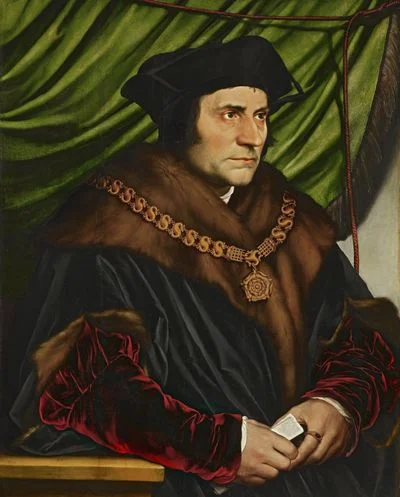
Thomas More was beheaded at Tower Hill. His last words declared he died the King's good servant but God's first. Canonized in 1935, he became the patron saint of lawyers and statesmen.