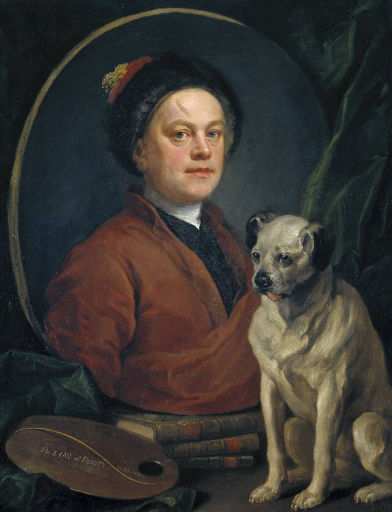
Quick Facts
A sharp-eyed London satirist who turned moral storytelling into vivid engravings and pioneering narrative painting.
Conversation Starters
Life Journey
Born in London to Richard Hogarth, a schoolmaster and Latin scholar, and Anne Gibbons. His father’s financial troubles and time in debtors’ prison later sharpened Hogarth’s sympathy for urban hardship and vice.
As a boy, Hogarth saw Richard Hogarth confined for debt, a common cruelty in early Georgian London. The family’s precarious position exposed him to the city’s harsh social hierarchy and fueled his later moral critique.
He entered an apprenticeship with silver-plate engraver Ellis Gamble, learning lettering, ornament, and precise line work. This commercial training gave him the technical command that later made his prints exceptionally legible and popular.
After apprenticeship, he set up independently, producing shop cards, book illustrations, and small commissions for London clients. The work immersed him in the city’s print market and taught him how images circulated among different classes.
Hogarth attended the informal St Martin's Lane Academy, where artists sketched from life and debated style outside rigid court taste. The milieu encouraged his preference for observation and character over idealized classical formulas.
His early satires gained notice in a booming London print culture shaped by politics, theater, and coffeehouse talk. By combining sharp facial caricature with readable storytelling, he began building a distinctive public reputation.
He eloped with Jane Thornhill, daughter of court painter Sir James Thornhill, provoking initial hostility from his influential father-in-law. The marriage later reconciled, linking Hogarth to prestigious artistic circles while he kept his independent voice.
He issued A Harlot's Progress, tracing a young woman’s ruin in London through prostitution, disease, and death. The series’ vivid interiors and social types made it a sensation, proving prints could deliver complex moral narratives to mass audiences.
Hogarth lampooned financial mania and corruption in The South Sea Scheme, reflecting memories of the 1720 bubble’s damage. By turning economic scandal into allegory, he showed how prints could critique modern commerce as well as private vice.
A Rake's Progress portrayed Tom Rakewell’s descent from inherited wealth to Bedlam, combining comedy with grim consequence. The same year, his lobbying helped secure the Engravers' Copyright Act, protecting artists from pirated copies in London’s market.
He mocked theatrical illusion by depicting exhausted performers preparing in a makeshift rural space, contrasting stage glamour with labor. The image also reflected London’s thriving theater world and Hogarth’s taste for behind-the-scenes realism.
He developed Marriage A-la-Mode, a biting story of an arranged aristocratic marriage collapsing into adultery, disease, and death. Its details targeted class vanity and transactional relationships amid London’s fashionable West End culture.
After exhibiting the paintings, Hogarth issued engraved versions to reach a wider public beyond elite collectors. The prints expanded his influence and demonstrated a modern model of artists controlling both fine art and mass reproduction.
He published Beer Street and Gin Lane, contrasting healthy labor with destructive gin addiction during debates over the Gin Acts. The paired images worked alongside reformers and magistrates to argue that policy and consumption shaped public welfare.
In The Analysis of Beauty, Hogarth argued that a “serpentine” line created visual vitality, challenging academic rules derived from classical art. The book sparked debate among artists and critics, revealing his ambition to theorize as well as satirize.
He became Serjeant Painter to King George II, a court appointment that brought status and official duties. Despite the honor, he continued to champion distinctly English subjects and resisted simply imitating continental grand style.
Late prints attacking political figures and factions drew fierce responses in London’s partisan press. The backlash showed how his visual language could inflame public debate, not just entertain, in an increasingly polarized political culture.
Hogarth died in London and was mourned as a founder of a distinctly British school of narrative art and satire. His prints continued circulating widely, influencing caricaturists and social critics well beyond Georgian England.