En bref
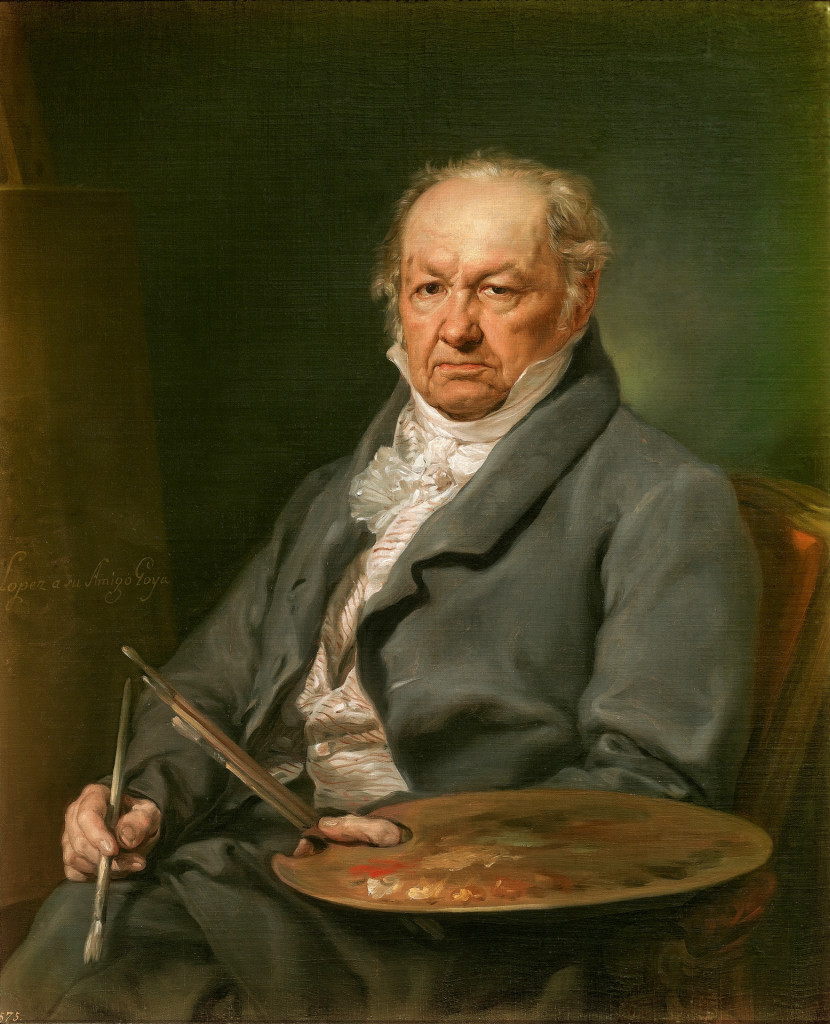
The Spanish Romantic painter and printmaker who created powerful works documenting the turmoil of his era, including 'The Third of May 1808' and the haunting 'Black Paintings'.
Sujets de conversation
Parcours de vie
Francisco José de Goya y Lucientes was born in the small village of Fuendetodos in the Kingdom of Aragon. His father was a gilder, and his mother came from a family of minor nobility, providing a modest start for the future painter.
Goya began a four-year apprenticeship with the local Baroque painter José Luzán. There, he learned the fundamentals of drawing and copying Old Masters, establishing the technical foundation for his artistic career.
Goya traveled to Madrid hoping to win a scholarship from the prestigious Royal Academy of Fine Arts of San Fernando. He was unsuccessful, reflecting the competitive artistic environment of the Spanish capital at the time.
Goya traveled to Italy to study classical and Renaissance art firsthand. His trip culminated in winning second prize in a painting competition held by the Academy of Parma, gaining valuable recognition.
Back in Spain, Goya received his first significant commissions to paint frescoes in the Basilica of Our Lady of the Pillar. This work established his reputation as a skilled muralist in his native Aragon.
Goya married Josefa Bayeu, the sister of the established court painter Francisco Bayeu. This marriage connected him to the artistic elite in Madrid and was crucial for his future career advancement.
Summoned by his brother-in-law, Goya moved to Madrid to design cartoons for the Royal Tapestry Factory. Over the next two decades, he created over 60 designs depicting lively scenes of Spanish life.
Goya was elected as a member of the Royal Academy of Fine Arts of San Fernando, the institution that had once rejected him. His admission piece was a religious painting titled 'Christ Crucified,' showcasing his mastery.
Goya was appointed as a painter to King Charles III, a significant step in his court career. This position provided him with a steady salary and greater access to the royal family and aristocracy.
Following the death of Charles III, the new King Charles IV promoted Goya to the prestigious position of Court Painter. This marked the peak of his official recognition and led to numerous royal portraits.
While visiting Seville, Goya suffered a severe, undiagnosed illness that left him permanently deaf. This personal catastrophe profoundly affected his personality and artistic vision, leading to a darker, more introspective style.
Goya published 'Los Caprichos,' a set of 80 etchings satirizing human folly, superstition, and the abuses of the Spanish establishment. Fearful of the Inquisition, he withdrew the series from sale after only two days.
He completed his monumental group portrait 'The Family of Charles IV.' The painting is renowned for its unflinchingly honest, almost critical, depiction of the royal family's character, showcasing Goya's psychological insight.
Napoleon's forces invaded Spain, beginning the bloody Peninsular War. Goya remained in Madrid under French occupation, an experience that deeply traumatized him and directly inspired his most powerful works of protest.
After the war, Goya created 'The Third of May 1808' to commemorate Spanish resistance to Napoleon's armies. The painting is a landmark in Western art for its raw, emotional portrayal of the horrors of war and political violence.
Goya bought a house outside Madrid called the Quinta del Sordo (Deaf Man's Villa). In his later years, he painted a series of dark, nightmarish murals directly onto its walls, now known as 'The Black Paintings.'
Disillusioned with the repressive regime of Ferdinand VII, Goya went into voluntary exile in Bordeaux, France. He was joined by his companion and caretaker, Leocadia Weiss, and her young daughter.
Despite his old age and poor health, Goya mastered the new technique of lithography. He produced his final great series, 'The Bulls of Bordeaux,' demonstrating his relentless artistic innovation until the very end.
Francisco de Goya died in Bordeaux at the age of 82 after suffering a stroke. His body was initially buried there, but in 1919 his remains were transferred to Madrid and interred at the Royal Chapel of St. Anthony of La Florida.