En bref
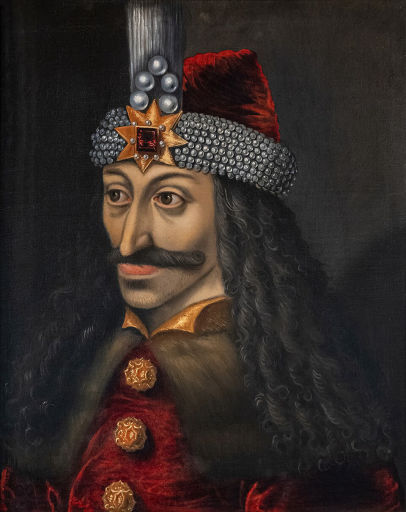
Feared Wallachian prince who wielded brutal justice and guerrilla warfare to defend his realm from Ottoman expansion.
Sujets de conversation
Parcours de vie
Born in Sighișoara to Vlad II Dracul and Princess Eupraxia, amid fierce struggles for the Wallachian throne. His father’s ties to the Order of the Dragon shaped the family’s anti-Ottoman reputation in the region.
Vlad II Dracul secured the Wallachian throne, forcing the family into constant negotiations with Hungary and the Ottoman Empire. Court life exposed Vlad to boyar rivalries and the fragile balance of tributary politics.
Vlad and his brother Radu were sent to the Ottomans as guarantees of their father’s loyalty to Sultan Murad II. They lived under supervision and learned Turkish, court protocol, and military discipline, while fearing execution for rebellion.
Vlad II Dracul was killed and Mircea II was reportedly buried alive after a coup backed by boyars and influenced by John Hunyadi’s faction. The killings hardened Vlad’s vendetta against the boyar elite he blamed for treachery.
With Ottoman support after the Battle of Kosovo, Vlad briefly seized the throne but lacked a durable base among Wallachian boyars. Rival claimant Vladislav II returned with Hungarian backing, forcing Vlad into flight and political exile.
Vlad sought refuge and support at the Moldavian court, building ties among regional rulers and mercenaries. He learned how quickly patrons changed and how diplomacy, not just battle, determined survival in the Carpathian frontier.
The assassination of Moldavia’s Bogdan II destabilized the region and pushed Vlad to search for stronger backing against Vladislav II. The episode reinforced his belief that preemptive violence could deter aristocratic conspiracies.
Vlad re-entered Wallachia and defeated Vladislav II near the Danube, likely exploiting Hungary’s post-Belgrade turmoil. He took the throne in Târgoviște and began consolidating power by targeting hostile boyar factions.
He promoted loyal lesser nobles and officials to weaken entrenched boyar clans that had toppled previous princes. Reports from Saxon towns and Wallachian chronicles describe harsh punishments designed to impose predictable authority.
Vlad clashed with Saxon merchants who supported rival claimants and resisted his trade controls, striking at Brașov and nearby settlements. The conflict mixed economic policy with intimidation, fueling German pamphlets about his brutality.
He reinforced fortifications and patrols to block Ottoman raiding and to control crossing points along the Danube. Wallachia’s strategy relied on mobile forces, scorched earth, and denying supplies to larger invading armies.
Vlad stopped paying tribute and attacked Ottoman positions south of the Danube, signaling open defiance of Sultan Mehmed II. His raids aimed to disrupt garrisons and intimidate collaborators, while courting Hungarian support for a crusade.
During Mehmed II’s invasion, Vlad launched a night assault seeking to kill the sultan and break Ottoman command cohesion. Though the attempt failed, it shocked the army and complemented scorched-earth tactics that starved invaders of supplies.
Mehmed II promoted Vlad’s brother Radu cel Frumos as a pliant ruler, drawing boyars to switch allegiance. Facing dwindling support, Vlad withdrew toward Transylvania to seek help from King Matthias Corvinus of Hungary.
Instead of receiving aid, Vlad was detained by Matthias Corvinus, who cited controversial letters portraying Vlad as unreliable. He spent years in custody, a pawn in Hungarian-Ottoman diplomacy and Transylvanian political maneuvering.
As Ottoman pressure intensified, Vlad was released and re-entered regional politics with Hungarian support and new alliances. He participated in campaigns alongside Stephen III of Moldavia, positioning himself for a return to Wallachia’s throne.
Vlad briefly regained the throne with backing from Matthias Corvinus and allies, but his position was precarious among divided boyars. Ottoman forces and local rivals quickly mobilized, turning his restoration into a short-lived last stand.
He was killed in late 1476 during fighting near Bucharest, amid clashes with Ottoman-aligned opponents and rival Wallachian factions. Accounts vary on betrayal versus battlefield death, but his fall again reshaped control of the principality.