Chumi
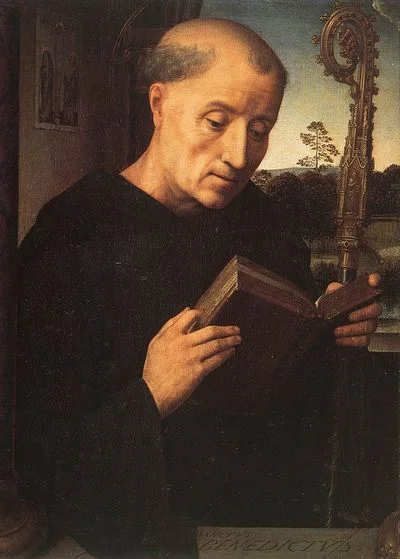
Benedict of Nursia

Benedict of Nursia

Monk

Start Chat

AI Personality

Quick Facts

Founder of the Benedictine Order
Rule of Saint Benedict
Patron Saint of Europe

Life Journey

480Birth in Nursia with Twin Sister

Benedict was born into a noble Roman family in Nursia, a small town in the mountains of central Italy. He had a twin sister, Scholastica, who would also become a saint. The Roman Empire in the West had recently collapsed, and Italy was in political and social turmoil, setting the stage for Benedict's mission to preserve civilization through monasticism.

494Sent to Rome for Education

Benedict's parents sent him to Rome for a classical education in rhetoric and law, accompanied by his nurse Cyrilla. Rome, though much diminished from its imperial glory, still offered the finest education available. The young Benedict excelled in his studies but was troubled by the moral laxity he witnessed among his fellow students.

497Abandons Studies and Worldly Life

Deeply disturbed by the immorality and corruption he witnessed in Rome, Benedict made the radical decision to abandon his studies and worldly prospects. His nurse Cyrilla accompanied him as he left the city, beginning a spiritual journey that would transform Western Christianity.

498First Miracle at Enfide

While staying in the village of Enfide with Cyrilla, Benedict performed his first miracle by repairing a broken earthenware tray through prayer. When word of this spread, Benedict fled the growing attention, seeking deeper solitude. He had discovered his calling but feared the corrupting influence of fame.

499Becomes a Hermit in Subiaco Cave

Benedict withdrew to a cave at Subiaco, high in the mountains, where he lived as a hermit for three years. A monk named Romanus helped him, lowering bread to his cave by a rope. In this solitude, Benedict battled fierce temptations and grew in prayer, developing the spiritual wisdom that would inform his Rule.

502Discovered by Shepherds

Local shepherds discovered Benedict, initially mistaking the wild-looking hermit for an animal. Recognizing his holiness, they began to seek his spiritual counsel. Word of his wisdom spread, and people from all walks of life came to him for guidance, drawing him reluctantly from his solitary contemplation.

505Failed Abbacy at Vicovaro

The monks of a nearby monastery at Vicovaro, lacking an abbot, begged Benedict to lead them. Despite his reluctance, he agreed. However, the monks soon regretted their choice when Benedict insisted on strict discipline. Some tried to poison him, but the cup shattered miraculously. Benedict returned to Subiaco, having learned about community life.

508Founds Twelve Monasteries at Subiaco

Disciples flocked to Benedict, and he organized them into twelve monasteries of twelve monks each, with himself as overall superior. This organizational structure allowed him to test different approaches to community life while maintaining unity through his guidance. The monasteries became schools of spiritual formation.

515Conflict with Priest Florentius

A local priest named Florentius, jealous of Benedict's influence, attempted to undermine his work through slander and even tried to corrupt his monks by sending prostitutes to the monastery. When Florentius died suddenly after a failed assassination attempt, Benedict wept over his enemy's fate, showing the depth of his charity.

529Founds Monte Cassino

Leaving Subiaco due to continued persecution, Benedict traveled south and founded his most famous monastery on Monte Cassino, the site of an ancient pagan temple to Apollo. He personally destroyed the pagan shrine and dedicated the site to Saint Martin. Monte Cassino would become the motherhouse of Western monasticism.

530Writes the Rule of Saint Benedict

Drawing on decades of experience, Benedict composed his Rule, a masterpiece of spiritual and practical wisdom. The Rule emphasized balance between prayer, work, and study; moderation in all things; obedience to the abbot; and stability in the community. It remains the foundational document for Benedictine life, influencing all subsequent Western monasticism.

532Establishes Nuns Community

Benedict's twin sister Scholastica established a convent of nuns at Plombariola, near Monte Cassino. Benedict adapted his Rule for her community, and the two siblings met once a year for spiritual conversation. Their relationship exemplified the complementary nature of male and female religious life in the Benedictine tradition.

534Miracle of the Gothic Youth

A Gothic youth named Exhilaratus came to Monte Cassino. Though barbarian and uneducated, he showed such virtue that Benedict received him as a monk. This openness to all peoples, regardless of ethnic or social background, became a hallmark of Benedictine monasticism, helping preserve Roman culture for medieval Europe.

542Meeting with King Totila

Totila, king of the Ostrogoths who was conquering Italy, visited Benedict at Monte Cassino. First he tested the saint by sending a servant disguised as himself, but Benedict was not fooled. When the real king came, Benedict prophesied his fate accurately, urging him to temper his cruelty. Totila was deeply impressed.

543Vision of the Whole World

One night, Benedict experienced a mystical vision in which he saw the entire world gathered up in a single ray of divine light. His companion Servandus asked how this was possible; Benedict explained that to one who sees the Creator, all creation seems small. This vision symbolized his role in gathering scattered humanity into the unity of monastic life.

545Final Meeting with Scholastica

Benedict met his sister for their annual spiritual conversation. When evening came, Scholastica begged him to stay and continue their talk, but Benedict refused, citing his Rule. She prayed, and a sudden storm made travel impossible. Three days later, Benedict saw her soul ascending to heaven as a dove. He buried her in the tomb prepared for himself.

546Prophesies Destruction of Monte Cassino

Benedict prophesied that Monte Cassino would be destroyed by barbarians, but that none of his monks would perish. This prophecy was fulfilled in 581 when the Lombards destroyed the monastery. The monks fled to Rome, carrying Benedict's Rule, which thus spread throughout Christendom. Monte Cassino was rebuilt and destroyed multiple times.

547Death Standing in Prayer

Benedict died on March 21, 547, standing upright in prayer, supported by his disciples in the chapel. He had predicted his death and prepared his monks. He was buried in the same tomb as his sister Scholastica. His Rule spread throughout Europe, and he is honored as the father of Western monasticism and patron of Europe.

Chat