Quick Facts
Last Mexica emperor who led a desperate, courageous defense of Tenochtitlan against Spanish conquest and allied forces.
Conversation Starters
Life Journey
Born in Tenochtitlan within the Mexica ruling elite, likely connected to the royal dynasty that governed the Triple Alliance. Raised amid ceremonial education and warfare training, he grew up as Spanish contact approached Mesoamerica.
As a youth he witnessed the New Fire Ceremony cycle that renewed Mexica ritual life and imperial legitimacy in Tenochtitlan. Public rites, tribute displays, and military parades reinforced expectations that nobles must defend the city and its gods.
He served in Mexica warfare that sustained tribute networks across central Mexico, where captives and alliances shaped political power. Battlefield discipline and leadership under veteran commanders prepared him for crisis as foreign intruders neared the Valley of Mexico.
Hernan Cortes arrived with Spanish troops and powerful Indigenous allies, including Totonacs and later Tlaxcalans, shifting regional politics. In Tenochtitlan, debates intensified over Moctezuma II's diplomacy and the mounting threat to Mexica sovereignty.
After Moctezuma II's death and the brief rule of Cuitlahuac, smallpox and war devastated leadership and population. The city faced hunger, fear, and factional pressure, making a decisive ruler essential as Spanish forces regrouped with allies.
Cuauhtemoc was chosen as Huey Tlatoani to lead the Mexica in emergency war leadership, emphasizing resistance over accommodation. His accession signaled a hardening stance toward Cortes and a determination to defend the island capital and its causeways.
He pressed surrounding altepetl to maintain tribute and military support, while confronting defections encouraged by Spanish promises and Tlaxcalan pressure. Messengers, war councils, and emergency provisioning aimed to keep Tenochtitlan fighting despite isolation.
Cortes returned with Spanish troops, Tlaxcalan allies, and brigantines built at Texcoco to control Lake Texcoco. Cuauhtemoc coordinated defense across canals and causeways, turning urban geography into a battlefield while supplies rapidly dwindled.
As the siege tightened, Mexica fighters contested every bridge, rooftop, and waterway, striking brigantines and ambushing patrols. Cuauhtemoc's leadership relied on rapid redeployment and morale under famine, disease, and constant bombardment.
With casualties soaring, he explored terms that might spare civilians while resisting total surrender to Cortes and allied forces. These talks reflected the collapse of food and fresh water and the desperate reality of a city being dismantled block by block.
On August 13, Spanish forces seized him as he attempted to flee across Lake Texcoco, ending organized Mexica resistance. Brought before Cortes, he became a political prize whose fate would shape the transition to Spanish rule in the ruined capital.
Spanish authorities, seeking gold lost during earlier fighting, subjected him and other nobles to torture, including burning of the feet in coercive interrogations. The episode exposed the conquest's brutality and Cuauhtemoc's refusal to betray his people under duress.
As Tenochtitlan was rebuilt into Mexico City, Cuauhtemoc lived as a closely watched captive amid the emerging Spanish administration. His presence symbolized potential rebellion, so Cortes and officials limited his movement and monitored his contacts with Nahua nobles.
Cortes marched toward Honduras to confront rivals and secure claims, taking Cuauhtemoc and other Indigenous elites as hostages and guides. The grueling journey through forests and swamps strained supplies and heightened Spanish paranoia about plots along the route.
Near Itzamkanac in the Maya region, Cortes accused Cuauhtemoc of planning an uprising and ordered his execution by hanging. His death removed the most prominent Mexica royal survivor and later fueled narratives of martyrdom and national resistance in Mexico.
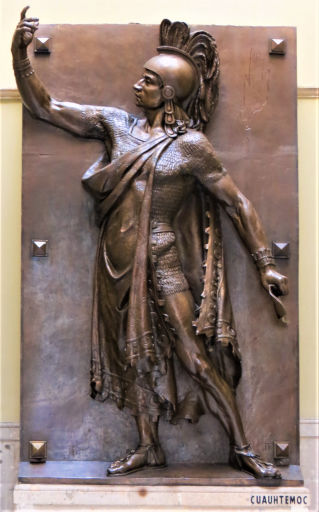
Accounts by chroniclers such as Bernal Diaz del Castillo and later Mexican historians shaped his image as a steadfast defender of sovereignty. Statues, place names, and civic commemorations in Mexico City and beyond turned Cuauhtemoc into a powerful emblem of identity.