Quick Facts
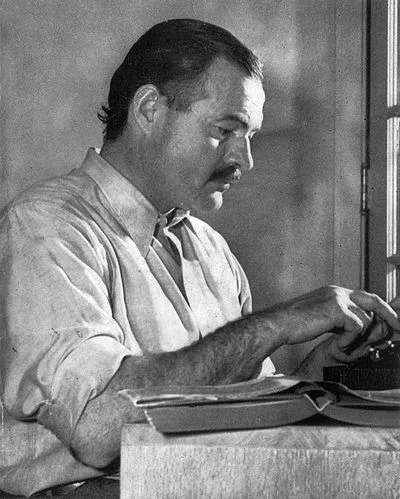
Old Man and the Sea. For Whom the Bell Tolls. Wrote prose as clean as a rifle shot.
Conversation Starters
Life Journey
Ernest Miller Hemingway was born in the Chicago suburb of Oak Park to a physician father and a musician mother. His childhood summers at the family cabin in Michigan developed his love of outdoor life.
After high school, Hemingway worked as a cub reporter for the Kansas City Star. The newspaper's style guide emphasizing short sentences and vigorous English influenced his literary style.
Hemingway was rejected for World War I military service due to poor eyesight. He volunteered as an ambulance driver for the Red Cross in Italy instead, eager to experience the war.
Hemingway was seriously wounded by mortar fire while distributing chocolate to soldiers. Despite over 200 shrapnel wounds, he carried an injured soldier to safety. The experience deeply marked his writing.
Hemingway married Elizabeth Hadley Richardson, the first of his four wives. They moved to Paris, where Hemingway worked as a foreign correspondent and became part of the expatriate literary scene.
Hemingway published his first significant book, 'In Our Time,' a collection of stories. The minimalist style and themes of violence and disillusionment established his distinctive voice.
Hemingway's first novel 'The Sun Also Rises' captured the 'Lost Generation' of post-war expatriates. The book made him a literary star and defined the era's disillusionment.
Hemingway's second novel drew on his WWI experience to tell a love story amid war. It cemented his reputation as a major American writer and sold over 80,000 copies in four months.
Hemingway covered the Spanish Civil War as a correspondent, supporting the Republican cause. His experiences informed his novel 'For Whom the Bell Tolls' and the documentary 'The Spanish Earth.'
Hemingway published his Spanish Civil War novel, which became a bestseller and was nominated for the Pulitzer Prize. He had settled in Cuba with his third wife, Martha Gellhorn.
Hemingway accompanied Allied forces on D-Day and was present at the Liberation of Paris. He allegedly led a band of resistance fighters, though this violated the rules for correspondents.
Hemingway published 'The Old Man and the Sea' in Life magazine, where it was read by 5 million people in two days. The novella restored his reputation after the poorly received 'Across the River and Into the Trees.'
Hemingway won the Pulitzer Prize for Fiction for 'The Old Man and the Sea.' The award recognized both the novella and his cumulative achievement in American literature.
Hemingway was awarded the Nobel Prize in Literature. Unable to attend due to injuries from two plane crashes in Africa, he sent an acceptance speech noting the writer's lonely life.
Hemingway's health deteriorated from the effects of heavy drinking, multiple injuries, and depression. He was treated for high blood pressure and liver disease, and began showing signs of mental illness.
Hemingway died from a self-inflicted shotgun wound at his home in Idaho. He had undergone electroconvulsive therapy for depression and complained it had destroyed his memory and ability to write.