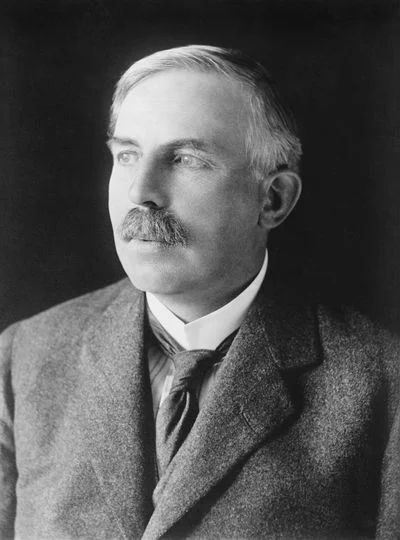
Quick Facts
Split the atom. Father of nuclear physics who discovered the nucleus and changed everything.
Conversation Starters
Life Journey
Ernest Rutherford was born as the fourth of twelve children to a Scottish immigrant flax farmer. Despite modest origins in rural New Zealand, he showed exceptional scientific aptitude from childhood.
Rutherford won a scholarship to Nelson College, where he excelled in mathematics and science. His teachers recognized his exceptional abilities and encouraged his academic ambitions.
Rutherford attended Canterbury College (now University of Canterbury), earning three degrees in mathematics and physics. He conducted research on magnetization of iron and became the first research student at New Zealand universities.
Rutherford won the prestigious 1851 Exhibition Scholarship to study at Cambridge University's Cavendish Laboratory under J.J. Thomson. He was among the first research students admitted from outside Cambridge.
Rutherford was appointed professor of physics at McGill University in Montreal. At 27, he had one of the best-equipped laboratories in the world and began his groundbreaking research on radioactivity.
Rutherford discovered that radioactive emissions consisted of two types: alpha particles and beta particles. This fundamental distinction was essential for understanding atomic structure.
Working with Frederick Soddy, Rutherford proved that radioactive decay involves transformation of one element into another. This revolutionary finding showed that atoms were not indivisible.
Rutherford moved to the University of Manchester as professor of physics. Here he assembled a brilliant research team and conducted his most famous experiments on atomic structure.
Rutherford was awarded the Nobel Prize in Chemistry for his investigations into the disintegration of elements. He joked that he had witnessed many transformations but none as rapid as his own from physicist to chemist.
Rutherford's gold foil experiment revealed that atoms have a tiny, dense nucleus containing most of their mass. This overturned the 'plum pudding' model and established the nuclear model of the atom.
Rutherford achieved the first artificial nuclear transmutation, converting nitrogen into oxygen by bombardment with alpha particles. He had 'split the atom,' opening the door to nuclear physics.
Rutherford succeeded J.J. Thomson as director of the Cavendish Laboratory at Cambridge. Under his leadership, the lab became the world's foremost center for nuclear physics research.
Rutherford theorized the existence of the neutron, a neutral particle in the atomic nucleus. James Chadwick would discover the neutron experimentally in 1932, confirming Rutherford's prediction.
Rutherford was created Baron Rutherford of Nelson and became the first New Zealand-born Nobel laureate to be elevated to the British peerage. He chose the name Nelson after his New Zealand birthplace.
Rutherford died unexpectedly from a strangulated hernia. He was buried in Westminster Abbey near Newton and Darwin. His work had founded nuclear physics and transformed our understanding of matter.