Quick Facts
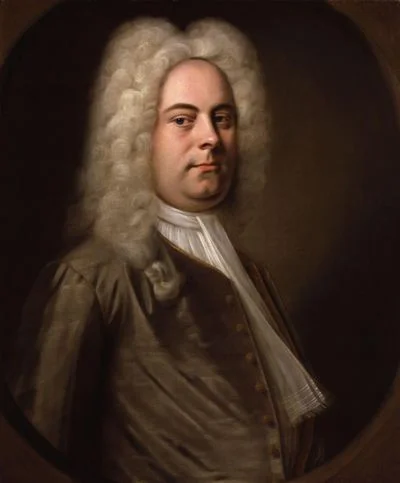
Hallelujah!" Handel's Messiah echoes; Baroque master of music and drama.
Conversation Starters
Life Journey
George Frideric Handel was born to a barber-surgeon who opposed his son's musical interests. Despite his father's wishes that he study law, young George practiced keyboard instruments secretly, showing early the determination that would characterize his career.
Handel studied music with Friedrich Zachow, organist of the Marktkirche, who taught him composition, organ, harpsichord, and violin. Zachow recognized his exceptional talent and gave him a thorough grounding in German and Italian musical styles.
To honor his late father's wishes, Handel enrolled in law at the University of Halle. He simultaneously took the position of cathedral organist, but after one year abandoned law entirely for music, following his true calling.
Handel moved to Hamburg, home of Germany's first public opera house. He played violin and harpsichord in the orchestra and befriended Johann Mattheson, with whom he traveled, dueled, and debated music—beginning his lifelong theatrical career.
Handel's first operas 'Almira' and 'Nero' premiered at the Hamburg opera with great success. The works displayed his gift for melody and drama, establishing him as a rising operatic composer before he turned twenty-one.
Handel traveled to Italy to study Italian opera and instrumental music at its source. He spent nearly four years in Florence, Rome, Naples, and Venice, absorbing Italian style and impressing the leading composers and patrons of the age.
Handel's oratorio 'La Resurrezione' premiered in Rome before a brilliant audience including Cardinals and princes. Performed with unprecedented lavish forces, it demonstrated his mastery of dramatic sacred music that would flower into the English oratorio.
Handel was appointed Kapellmeister to the Elector of Hanover, the future King George I of England. The position gave him security while allowing extended leaves, and his relationship with the Hanoverian court would prove fateful.
Handel's 'Rinaldo,' the first Italian opera written specifically for London, was a sensational success. The spectacular staging and brilliant music created a fashion for Italian opera in England that Handel would dominate for decades.
Handel's patron became King of England, awkwardly since Handel had overstayed his leave in London. The famous story that 'Water Music' restored him to favor is probably legend, but Handel certainly prospered under the new Hanoverian regime.
Handel became musical director of the Royal Academy of Music, a company formed to produce Italian operas. He traveled to recruit singers and for the next decade created a stream of masterpieces while battling rival companies and temperamental stars.
Handel composed four anthems for the coronation of George II, including 'Zadok the Priest,' which has been performed at every British coronation since. These works established him as the composer of British state occasions.
Years of overwork and stress from failing opera companies caused Handel's physical collapse, possibly a stroke. After treatment at Aachen's hot baths, he recovered remarkably and returned to composing with renewed energy and new directions.
Handel composed 'Messiah' in just 24 days, reportedly declaring after writing the Hallelujah chorus that he had 'seen all Heaven before me.' The oratorio premiered in Dublin for charity and became the most frequently performed choral work in Western music.
Handel composed this orchestral suite for outdoor performance celebrating the Peace of Aix-la-Chapelle. The public rehearsal drew twelve thousand people, and though the actual fireworks caused a fire, the music remained a triumph.
Handel's eyesight failed completely after unsuccessful operations by the same surgeon who had blinded Bach. Despite blindness, he continued to perform organ concertos from memory and to revise his oratorios until his final days.
Handel died in London eight days after his last performance of 'Messiah.' He was buried in Westminster Abbey beneath a monument depicting him holding the score of the aria 'I know that my Redeemer liveth.' He left a legacy that defined English musical life.