Quick Facts
Peas unlocked heredity," founding genetics.
Conversation Starters
Life Journey
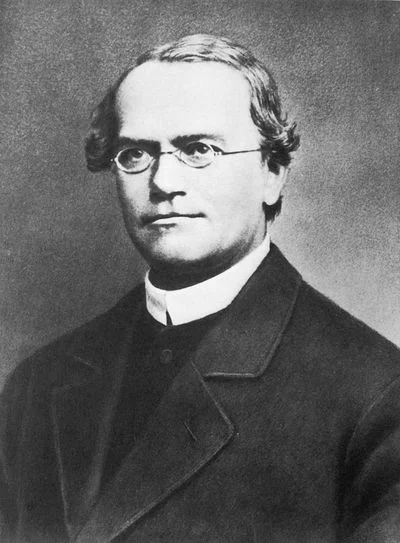
Johann Mendel was born to peasant farmers Anton and Rosine Mendel, destined to become the father of modern genetics.
Mendel enrolled at the Gymnasium in Troppau, excelling in physics and mathematics despite financial hardship.
Mendel joined the Augustinian St. Thomas's Abbey, taking the religious name Gregor and gaining access to education.
Mendel was ordained as a Catholic priest, though he struggled with pastoral duties and preferred teaching and research.
Mendel was sent to Vienna to study physics and natural sciences, learning experimental methods that would shape his research.
Mendel started teaching physics and natural history at the Brünn Realschule while beginning his famous experiments.
Mendel started his rigorous eight-year experiments on pea plants in the monastery garden, studying 29,000 plants.
Mendel concluded his experiments and formulated the Laws of Inheritance that would become the foundation of genetics.
Mendel presented his groundbreaking paper 'Experiments on Plant Hybridization' to the Natural History Society of Brünn.
Mendel's paper was published in the society's journal, establishing the principles of heredity, though largely ignored at the time.
Mendel was elected Abbot of the monastery, administrative duties which would consume most of his remaining time.
Mendel became embroiled in a prolonged dispute with the government over monastery taxation, refusing to pay on principle.
Mendel pursued meteorological studies, becoming a respected weather observer and publishing on tornado patterns.
Mendel received the Order of Francis Joseph for his contributions to meteorology and civic service, not genetics.
Gregor Mendel died of kidney disease, his genetic discoveries unrecognized until rediscovery in 1900 by de Vries, Correns, and von Tschermak.