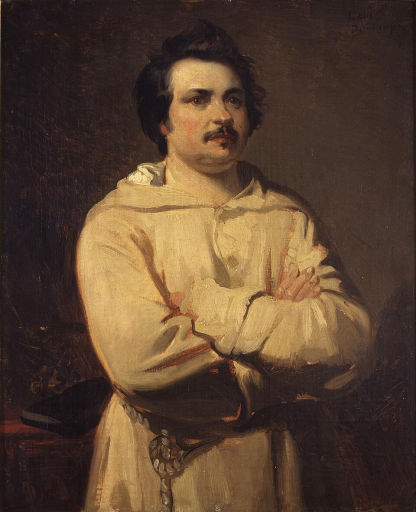
Quick Facts
A towering realist who mapped French society with ambitious novels, sharp observation, and relentless literary productivity.
Conversation Starters
Life Journey
Born in Tours as Honore Balzac to Bernard-Francois Balssa and Anne-Charlotte Sallambier. Growing up amid the aftermath of the French Revolution shaped his lifelong fascination with class mobility and power.
He entered the College of Vendome, where isolation and strict discipline left a lasting mark. The experience fed his later portrayals of youthful ambition, resentment, and social constraint in French life.
The Balzac family relocated to Paris as Napoleon’s era ended and the Bourbon Restoration began. The capital’s salons, law offices, and publishing world became his laboratory for observing modern society.
He studied law and worked as a clerk in legal offices, learning the mechanics of contracts, inheritance, and litigation. That practical knowledge later animated his intricate plots about money and family strategy.
Against his family’s wishes, he chose to write and lived austerely in a garret-like routine. Early struggles in the Restoration-era book market hardened his resolve and sharpened his sense of readers’ tastes.
He produced apprentice novels and pamphlets under various pseudonyms, absorbing the economics of serialization and popular genres. The grind taught him speed, structure, and how printers and booksellers shaped literature.
Balzac invested in printing and publishing schemes, hoping to become a businessman as well as an author. When the ventures faltered, crushing debts followed and became a lifelong pressure driving his prodigious output.
He published Les Chouans, blending historical conflict with acute social observation during the Restoration period. The novel helped establish him as a serious writer and opened doors to influential Parisian networks.
As the July Revolution reshaped France, he released stories later grouped as Scenes de la vie privee. Their intimate realism and moral edge signaled his ambition to portray society with near-scientific scope.
He received a letter from the Polish aristocrat Ewelina Hanska, initiating an intense, years-long relationship. Their correspondence mixed romantic aspiration with practical concerns about status, travel, and reputation.
Eugenie Grandet portrayed Saumur’s tight-laced bourgeois world and the corrosive force of avarice. Its psychological precision and economic detail strengthened his standing as a leading realist of modern France.
He began systematically linking characters across novels, imagining a single vast panorama of French life. This structural innovation mirrored social interdependence, turning recurring figures into a living network of ambition.
Pere Goriot introduced unforgettable figures like Eugene de Rastignac within the boarding house of Madame Vauquer. Its tragic vision of money, family, and social climbing became central to his evolving Comedie Humaine.
He organized his works under the banner La Comedie Humaine, aiming to classify society like a naturalist. Publishers, deadlines, and creditors pressed him, yet he pursued an unprecedented unity of theme and character.
Lost Illusions traced Lucien de Rubempre’s rise and fall amid Parisian journalism and publishing intrigues. Balzac dissected bribery, reviews-for-sale, and the price of fame in a rapidly commercializing culture.
He expanded his social panorama with Splendors and Miseries of Courtesans, weaving police power, vice, and aristocratic hypocrisy. The novel’s darkness reflected his mature realism and the era’s anxious urban modernity.
After long obstacles of inheritance and family consent, he finally married Ewelina Hanska. The union crowned a legendary correspondence, though his health was already failing from years of overwork and strain.
He died in Paris after declining health, worn down by intense writing schedules and chronic financial stress. His Comedie Humaine endured as a defining map of 19th-century French society and its moral economies.