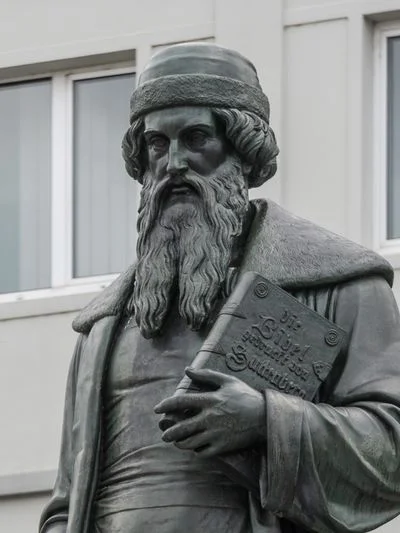
Quick Facts
Printing press changed the world more than any invention since writing itself.
Conversation Starters
Life Journey
Johannes Gensfleisch zur Laden zum Gutenberg was born into a patrician family. His father was a merchant involved in the church trade.
Guild uprisings forced patrician families including the Gutenbergs to leave Mainz. They relocated to nearby areas.
Likely studied at the University of Erfurt where he would have learned Latin, theology, and possibly metalworking.
Documented living in Strasbourg where he worked as a goldsmith and began secret experiments with printing technology.
Entered into a partnership to develop a secret invention, believed to be early printing press experiments.
A lawsuit after partner's death revealed Gutenberg was working on a secret project involving a press, types, and forms.
Returned to his hometown of Mainz with advanced printing technology. Borrowed money to establish a printing workshop.
Johann Fust invested 800 guilders in Gutenberg's printing venture, beginning a partnership that would prove fateful.
Began printing the 42-line Bible, the first major book printed using movable metal type in Europe.
Perfected the system of movable metal type, oil-based ink, and wooden printing press that would revolutionize communication.
The 42-line Bible was completed, approximately 180 copies printed on paper and vellum. A masterpiece of craftsmanship.
Johann Fust sued Gutenberg for repayment of loans. Gutenberg lost and had to surrender his printing equipment and types.
Established a new smaller printing workshop, possibly with help from other investors. Continued printing but on smaller scale.
May have operated a printing shop in Bamberg, producing a 36-line Bible and other works.
Mainz was sacked in a conflict between archbishops. Many printers fled, spreading printing technology across Europe.
Archbishop Adolf von Nassau gave Gutenberg a position as gentleman of the court with annual provisions of grain, wine, and clothing.
Gutenberg died and was buried in the Franciscan church in Mainz. The church and grave were later destroyed.
By 1500, printing presses operated in 270 European cities. Gutenberg's invention enabled the Reformation, Scientific Revolution, and modern world.