Quick Facts
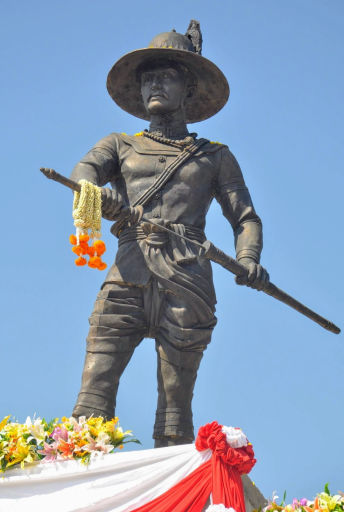
A resilient Thai war-leader who reunified Siam after Ayutthaya’s fall, founding Thonburi and expanding regional power.
Conversation Starters
Life Journey
Born in the Ayutthaya Kingdom to a Siamese mother and a Chinese father associated with merchant networks. Raised amid court politics and river trade, he learned how commerce and military power shaped Siam’s survival.
As a teenager he was brought into administrative service linked to the Ayutthaya court, gaining literacy and exposure to Buddhist institutions. Contacts with officials and monks later helped him mobilize men, supplies, and legitimacy.
He rose through provincial appointments where policing, taxation, and local defense were tightly connected. These roles trained him to recruit troops quickly and to use river routes to move rice, weapons, and intelligence.
He became governor of Tak on the western frontier, a region exposed to Burmese pressure and border raiding. The post made him skilled at fortifying towns, negotiating with local leaders, and fighting with limited resources.
When the Konbaung Burmese armies pushed into Siam, he served as a field commander during the desperate defense. The siege revealed the court’s paralysis and convinced him that only decisive mobile warfare could save survivors.
As Ayutthaya’s defenses collapsed, he led a daring breakout with loyal troops, avoiding Burmese patrols and hostile factions. The escape preserved a nucleus of command that later attracted refugees, sailors, and provincial militias.
He seized Chanthaburi, a port region with shipbuilders and access to Chinese trade goods and weapons. By securing food stores and maritime supply lines, he created a staging ground to retake the central plain.
From the east he advanced along the Gulf coast and river mouths, driving out Burmese detachments and local strongmen. Control of Thonburi gave him a defensible river capital and a chokepoint over regional trade.
He was proclaimed king and established Thonburi as the seat of a restored Siamese state after Ayutthaya’s ruin. He relied on merit-based commanders and tight logistics to project authority over fractured provinces.
He campaigned against competing claimants who had carved Siam into regional fiefdoms after 1767. By combining amnesty offers with swift assaults, he rebuilt a single chain of command and stabilized tax collection.
From Thonburi he restored corvée labor systems, rebuilt fortifications, and prioritized rice transport on the Chao Phraya waterways. These reforms enabled year-round campaigning and revived markets damaged by war and famine.
His forces pushed into contested Khmer borderlands where Siam, Vietnam, and local nobles competed for succession and tribute. The campaigns secured captives and resources while asserting Siamese prestige across the lower Mekong.
He supported northern allies and generals who recaptured Chiang Mai, reducing Burmese influence in Lanna. The shift reopened trade routes to Yunnan-linked markets and provided manpower from northern principalities for later wars.
He patronized monasteries and attempted to restore discipline in the sangha after wartime disruption. Royal support for ordinations and temple rebuilding helped present him as a righteous protector in a time of upheaval.
Siamese armies moved into Laos, taking Vientiane and compelling tribute from Lao rulers amid regional rivalry. The campaign increased Siam’s leverage in the Mekong basin and brought prized cultural and religious assets to Siam.
Late in his reign, reports of harsh punishments and escalating suspicion strained relations with nobles and senior monks. Political stress in the capital undermined loyalty among commanders who had once depended on his favor.
A crisis in Thonburi culminated in his removal as leading military figures consolidated power around the future Rama I. The transition shifted the capital across the river to Bangkok and reshaped Siam’s royal institutions.
He died soon after being deposed, closing a turbulent era defined by reunification and relentless campaigning. His legacy endured in the survival of an independent Siam and the foundations for Bangkok’s later expansion.