Quick Facts
Stopped the sun, moved the Earth. Revolution that displaced humanity from the center.
Conversation Starters
Life Journey
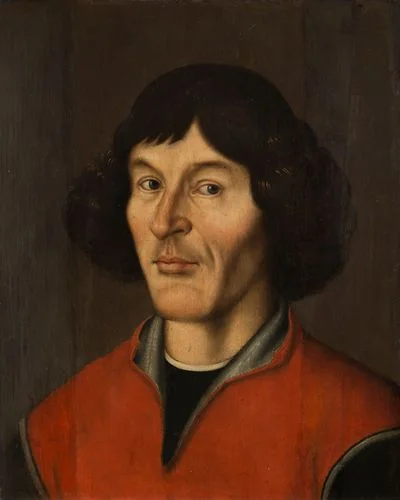
Nicolaus Copernicus was born to a prosperous merchant family in Toruń, a city under the Polish Crown. His father was a copper trader, and his mother came from a wealthy merchant family. He was the youngest of four children.
After his father's death, Copernicus came under the guardianship of his maternal uncle Lucas Watzenrode, a powerful church official who would later become Bishop of Warmia. His uncle ensured he received an excellent education.
Enrolled at the University of Kraków, one of Europe's leading centers of astronomical and mathematical studies. Here he first encountered astronomical instruments and began his lifelong fascination with the heavens.
Traveled to Italy to study canon law at the University of Bologna. He also studied astronomy with Domenico Maria Novara, making his first recorded astronomical observation—an occultation of the star Aldebaran by the Moon.
Visited Rome during the Papal Jubilee, where he reportedly gave lectures on astronomy and mathematics. He also observed a lunar eclipse, continuing to gather observations that would later support his heliocentric theory.
Enrolled at the University of Padua to study medicine, which he would practice as personal physician to his uncle and other church officials. He also continued his astronomical studies during this time.
Received his doctorate in canon law from the University of Ferrara. After nearly a decade in Italy absorbing Renaissance learning, he returned to Poland to begin his ecclesiastical career.
Returned to Poland and served as secretary and personal physician to his uncle, Bishop Lucas Watzenrode. He lived at the bishop's palace in Lidzbark Warmiński while beginning his duties as a canon of Frombork Cathedral.
After his uncle's death, Copernicus settled permanently in Frombork, where he would spend most of his remaining life. He built an observation tower and began systematic astronomical observations while fulfilling his duties as canon.
Wrote and privately circulated the 'Commentariolus' (Little Commentary), a brief manuscript outlining his heliocentric hypothesis. This was the first written presentation of his revolutionary idea that Earth and planets revolve around the Sun.
Presented his treatise on monetary reform to the Prussian Diet, proposing solutions to currency debasement. His economic insights, including an early formulation of Gresham's law, showed his wide-ranging intellectual abilities.
During the Polish-Teutonic War, Copernicus organized the military defense of Olsztyn against the invading Teutonic Knights. He demonstrated leadership and administrative skills beyond his scholarly pursuits.
Completed his economic treatise including theories on money and bread pricing regulations. He applied mathematical rigor to economic problems, showing the practical applications of his analytical mind.
Was invited to consult on calendar reform for the Catholic Church, recognizing that accurate astronomical knowledge was needed. He declined direct involvement, feeling his solar theory needed further refinement before being applied.
Georg Joachim Rheticus, a young German mathematician, traveled to Frombork to learn from Copernicus. Rheticus became his only disciple and convinced the aging astronomer to finally publish his complete work.
Rheticus published the 'Narratio Prima' (First Account), the first printed description of Copernican theory. This introduction to Copernicus's ideas prepared the scholarly world for the full publication to come.
The manuscript of 'De Revolutionibus Orbium Coelestium' was sent to Nuremberg for printing. Copernicus entrusted the publication to Rheticus, who later had to leave it in the hands of theologian Andreas Osiander.
His masterwork 'De Revolutionibus Orbium Coelestium' (On the Revolutions of the Celestial Spheres) was finally published. Legend has it that he received a copy on his deathbed. The book proposed that Earth rotates daily and revolves annually around the Sun.
Died on May 24, 1543, reportedly after suffering a stroke. According to legend, he was presented with a copy of his printed book on his deathbed. He was buried in Frombork Cathedral, where his remains were identified and reburied with honors in 2010.