Quick Facts
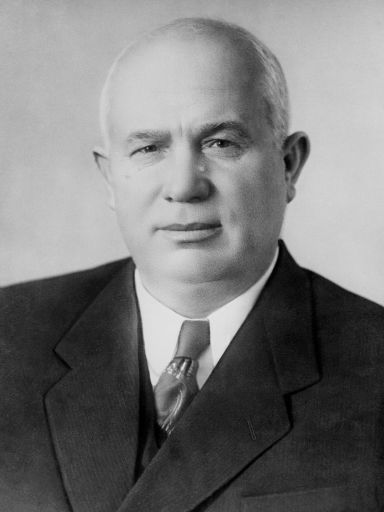
A blunt, energetic Soviet reformer who challenged Stalinism, faced the Cuban Missile Crisis, and reshaped Cold War politics.
Conversation Starters
Life Journey
Born to Sergei Khrushchev and Kseniya Khrushcheva in the village of Kalinovka in the Russian Empire. His childhood was marked by poverty, seasonal labor, and limited schooling typical of rural border regions.
Relocated with family to the Donbas industrial area, taking jobs as a metalworker and apprentice in factories and mines. The harsh conditions and labor politics of Yuzovka shaped his early views on class and power.
The upheavals of 1917 brought competing authorities, strikes, and armed conflict across Ukraine and southern Russia. He aligned with Bolshevik organizers in the working-class milieu that favored Soviet power over the old regime.
Entered the Bolshevik Party during the Russian Civil War, when loyalty and discipline were prized above all. Party membership opened a path from shop-floor labor to administrative roles in the new Soviet state.
Advanced through local party committees as the USSR consolidated under Vladimir Lenin’s successors. He gained a reputation as a tough, hands-on organizer who could enforce directives and manage cadres in unstable regions.
Moved to Moscow for training at the Stalin Industrial Academy, a key pipeline for technical and political elites. There he built networks inside the party apparatus that later helped his rapid ascent.
By the mid-1930s he held influential posts tied to Moscow’s party organization under Joseph Stalin. Operating in a climate of fear, he learned the brutal mechanics of patronage, denunciation, and centralized control.
The Great Purge devastated Soviet institutions, removing rivals and terrifying officials across the USSR. He rose as purges opened vacancies, while the NKVD’s arrests and executions reshaped the party he served.
Assigned to lead the Ukrainian party organization after purges and political turmoil weakened local leadership. He oversaw industrial priorities and party discipline in a strategically vital republic bordering Europe.
After Operation Barbarossa, he served as a political commissar and senior party representative in wartime councils. He worked alongside commanders in coordinating mobilization, morale, and industrial evacuation under extreme pressure.
With victory secured, he helped manage reconstruction in the Ukrainian SSR, rebuilding cities and heavy industry damaged by the war. Food shortages and partisan conflict made governance harsh and politically fraught.
Following Joseph Stalin’s death, a power struggle unfolded among Georgy Malenkov, Lavrentiy Beria, and other leaders. Khrushchev maneuvered within the Presidium and party machine to secure the top party post.
At the 20th Party Congress, he condemned Stalin’s cult of personality and mass repression in a closed session. The speech shocked delegates, triggered de-Stalinization, and reverberated through communist parties worldwide.
Party elders including Vyacheslav Molotov, Georgy Malenkov, and Lazar Kaganovich tried to unseat him in the Presidium. He rallied support through the Central Committee, sidelining rivals and strengthening his authority.
He toured the United States and met President Dwight D. Eisenhower, projecting confidence and seeking diplomatic openings. The trip mixed spectacle with serious talks, highlighting nuclear rivalry and competing economic models.
Tensions over Berlin escalated as East Germany faced mass emigration and legitimacy crises. The Berlin Wall was erected under Soviet-bloc pressure, hardening the Cold War boundary in Europe for a generation.
He approved deploying Soviet missiles to Cuba and then faced U.S. pressure under President John F. Kennedy. The crisis ended with negotiated withdrawal and secret tradeoffs, becoming a defining episode of brinkmanship.
Amid criticism of economic disruptions and erratic leadership style, Leonid Brezhnev and allies organized his ouster. He was forced to resign and replaced, marking a sharp end to the reformist momentum of his era.
He lived quietly under surveillance, writing memoirs that later shaped Western understanding of Soviet politics. He died in 1971 and was buried at Novodevichy Cemetery rather than the Kremlin Wall necropolis.