Quick Facts
Know thyself": Plato's Academy birthed Western thought; still shaping minds.
Conversation Starters
Life Journey
Alfred North Whitehead wrote that all Western philosophy is 'footnotes to Plato.' His influence spans epistemology, metaphysics, ethics, politics, aesthetics, and mathematics. The Academy became the model for universities. His dialogues are still read, debated, and taught worldwide. The philosopher who sought eternal truths achieved a kind of immortality.
Emperor Justinian closed the Academy after 916 years of continuous operation. Pagan philosophy was now banned in the Christian empire. But Plato's ideas had already entered Christian theology through Neoplatonism. His Forms became the thoughts of God, and philosophy merged with faith.
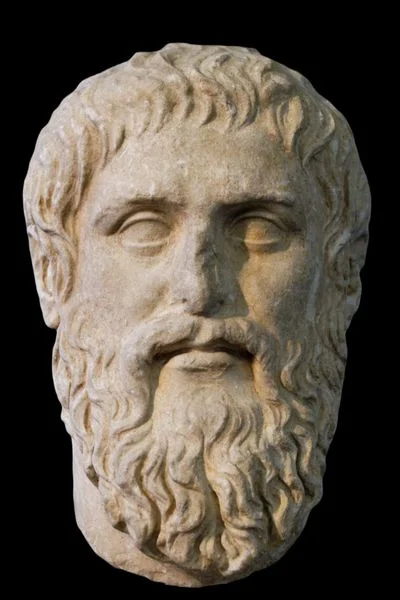
Plato was born into one of Athens' most distinguished aristocratic families during the Peloponnesian War. His father Ariston claimed descent from Codrus, the last king of Athens. Named Aristocles after his grandfather, he later acquired the nickname 'Plato' meaning 'broad'āperhaps for his physique or the breadth of his intellect.
Young Plato grew up during Athens' disastrous war with Sparta. He watched the plague ravage the city and witnessed the political instability that followed Pericles' death. These experiences of democracy's failures would profoundly shape his political philosophy and his skepticism of mob rule.
Plato encountered Socrates and became his devoted student. The older philosopher's method of relentless questioning transformed the young aristocrat. Plato abandoned his political ambitions and literary pursuits to follow this barefoot sage through the streets of Athens, seeking wisdom through dialectical inquiry.
Athens surrendered to Sparta, ending the Peloponnesian War. The victors installed the Thirty Tyrants, a brutal oligarchy that included Plato's relatives. Plato initially hoped for reform, but the regime's violenceāincluding attempts to involve Socrates in their crimesādisillusioned him with politics entirely.
The Thirty Tyrants were overthrown and democracy restored. Plato watched this democratic government prosecute his mentor Socrates for corrupting youth and introducing new gods. The city that had produced tragedy and philosophy now sentenced its wisest citizen to death. Plato's disillusionment deepened.
Socrates was executed by drinking hemlock, surrounded by his students. Plato, reportedly ill, was not present but later immortalized the scene in his dialogue Phaedo. The execution of the man he called 'the wisest and most just' haunted Plato forever and became the central trauma driving his philosophical mission.
After Socrates' death, Plato left Athens with other disciples. He traveled to Megara, then possibly to Egypt and Cyrene. These journeys exposed him to different philosophical traditions and mathematical knowledge. The young philosopher was gathering the intellectual materials for his own systematic philosophy.
Plato traveled to Syracuse, where he befriended Dion, brother-in-law of the tyrant Dionysius I. Plato hoped to influence the ruler toward philosophy, but his frankness about tyranny angered Dionysius. Legend says the tyrant sold Plato into slavery, though he was ransomed by friends. The dream of the philosopher-king survived.
Plato established his school in a grove sacred to the hero Academus, giving it the name that would become synonymous with learning. The Academy was the first institution of higher learning in the Western world. Here students studied mathematics, astronomy, and philosophy for over 900 years until closed by Justinian in 529 AD.
Plato composed his philosophical works as dramatic dialogues, usually featuring Socrates. Unlike other philosophers who wrote treatises, Plato created philosophical literatureāthe Republic, Symposium, Phaedrusāthat brought abstract ideas to life through character and conversation. His literary genius made philosophy accessible and beautiful.
Plato developed his most influential doctrine: the Theory of Forms. He argued that beyond our world of changing appearances exists a realm of eternal, perfect Formsāthe Good, the Beautiful, the Just. Our world is merely shadow and imitation. Philosophy meant ascending from shadows to contemplate eternal realities.
A seventeen-year-old Macedonian named Aristotle arrived at the Academy. Plato reportedly called him 'the mind of the school.' For twenty years Aristotle studied under Plato, eventually developing his own rival philosophy. The teacher-student relationship between these two titans shaped all subsequent Western thought.
When Dionysius I died, Dion invited Plato to educate the new tyrant, Dionysius II. Plato returned to Syracuse, hoping to create a philosopher-king. But court intrigues and the young tyrant's resistance to philosophy frustrated the mission. Dion was exiled, and Plato returned to Athens disappointed.
Despite previous failures, Plato made one final attempt to realize his political ideals in Syracuse. The situation quickly deteriorated. Dionysius II refused to recall Dion and virtually imprisoned Plato. Only intervention by the Pythagoreans of Tarentum secured Plato's release. The philosopher-king remained a dream.
Plato's masterwork, the Republic, presented his vision of the ideal state ruled by philosopher-kings. Through the Allegory of the Cave, the Allegory of the Sun, and the divided line, he argued that only philosophers who have contemplated the Form of the Good can rule justly. It remains the most influential work of political philosophy ever written.
Dion briefly seized power in Syracuse but was assassinated by his own allies. Plato's beloved student, the hope for philosophical governance in the real world, died violently. Plato wrote a bitter letter condemning the murderers. His dream of philosophy transforming politics seemed impossible.
In his final work, the Laws, Plato offered a more practical political philosophy. No longer trusting philosopher-kings, he designed a mixed constitution with detailed laws governing every aspect of life. The aging philosopher had become more realistic about human nature while never abandoning his vision of the good life.
Plato died in Athens at approximately eighty-one years old, reportedly while writing. Ancient sources say he died peacefully, perhaps at a wedding feast. He was buried on the grounds of his Academy. His nephew Speusippus succeeded him as head of the school, continuing the philosophical tradition Plato had founded.