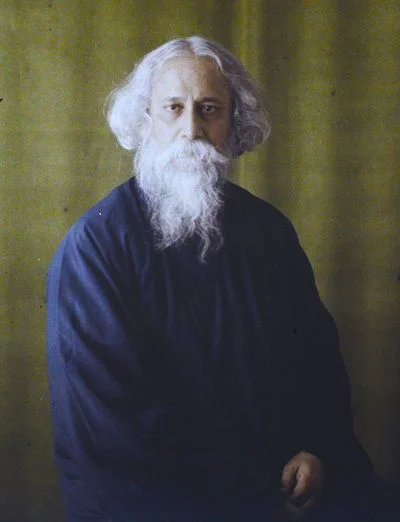
Quick Facts
Gitanjali. First non-European Nobel laureate. Poet who gave India its national anthem.
Conversation Starters
Life Journey
Rabindranath Tagore was born as the youngest of thirteen children to Debendranath Tagore and Sarada Devi. The Tagore family was one of the most prominent in Bengal, known for their contributions to arts, culture, and the Bengal Renaissance.
At the remarkably young age of eight, Tagore published his first poem. His early exposure to literature, music, and art within the culturally rich Tagore household nurtured his prodigious creative talents from childhood.
Following his Upanayana ceremony, Tagore accompanied his father on a months-long tour of the Himalayas. This journey profoundly influenced his spiritual development and deepened his connection to nature and Indian philosophy.
Tagore traveled to England to study law at University College London. Though he did not complete his degree, his exposure to Western literature, particularly Shakespeare and the English Romantics, significantly influenced his literary development.
Tagore married Mrinalini Devi, who was then just ten years old, following the customs of the time. Despite the arranged nature of their marriage, they developed a loving relationship and had five children together.
Tagore took charge of his family's estates in Shelaidaha. Living among rural peasants, he developed deep empathy for ordinary people, which profoundly influenced his writings and later his educational philosophy.
The publication of Manasi marked Tagore's emergence as a major literary figure. This collection showcased his mastery of Bengali verse and his ability to blend traditional Indian themes with modern sensibilities.
Tagore established an experimental school at Santiniketan, emphasizing open-air classes, self-expression, and connection with nature. This revolutionary approach to education would later evolve into Visva-Bharati University.
Mrinalini Devi died after a long illness, leaving Tagore devastated. The grief from this loss, followed by the deaths of two of his children within the next few years, profoundly deepened the emotional intensity of his poetry.
Tagore completed Gitanjali (Song Offerings), his most celebrated collection of spiritual poems. He later translated these devotional songs into English prose, which would bring him international recognition.
Tagore's English translation of Gitanjali was introduced to London's literary elite by William Rothenstein and W.B. Yeats. Yeats wrote an enthusiastic introduction, calling the poems 'the work of a supreme culture.'
Tagore became the first non-European to win the Nobel Prize in Literature, recognized for Gitanjali's 'profoundly sensitive, fresh, and beautiful verse.' This achievement brought global attention to Indian literature and culture.
King George V conferred knighthood upon Tagore in recognition of his literary achievements. However, Tagore would later renounce this honor in protest against British colonial policies in India.
Following the Jallianwala Bagh massacre where British troops killed hundreds of unarmed Indians, Tagore returned his knighthood in protest. His letter to the Viceroy became a powerful statement against colonial violence.
Tagore founded Visva-Bharati as an international university dedicated to bridging Eastern and Western cultures. He used his Nobel Prize money to fund this institution, which remains a leading center of learning today.
At nearly seventy, Tagore took up painting seriously after discovering artistic expression through doodling in his manuscripts. His works, characterized by bold colors and primal forms, were exhibited internationally.
Tagore delivered the prestigious Hibbert Lectures at Oxford University, later published as 'The Religion of Man.' These lectures presented his philosophical synthesis of Eastern spirituality and Western humanism.
Rabindranath Tagore died in his ancestral home in Calcutta after a prolonged illness. He left behind a vast legacy including over 2,000 songs, countless poems, novels, plays, paintings, and two national anthems for India and Bangladesh.