Chumi
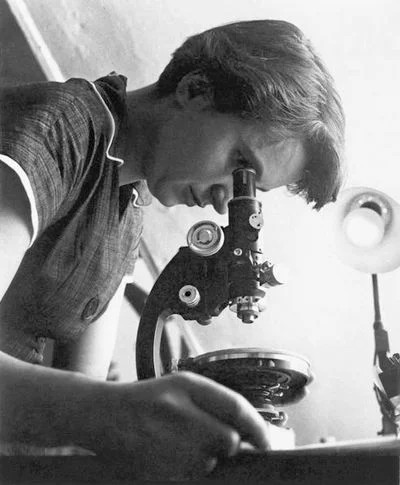
Rosalind Franklin

Rosalind Franklin

Chemist

Start Chat

AI Personality

Quick Facts

DNA Structure
Photo 51
X-ray Diffraction

Life Journey

1920Birth in London

Rosalind Elsie Franklin was born into a prominent Anglo-Jewish family in Notting Hill, London. Her father Ellis Franklin was a merchant banker, and her family valued education and public service. She showed exceptional intelligence and curiosity from an early age.

1926Early education at Norland Place School

Young Rosalind attended Norland Place School where her exceptional abilities in science and mathematics became apparent. Her aunt Mamie noted that she could not simply accept facts but always wanted to know the evidence behind them, foreshadowing her scientific approach.

1931Attends St Paul's Girls' School

Franklin entered St Paul's Girls' School, one of the few schools in London that taught physics and chemistry to girls. She excelled in sciences and languages, winning prizes in chemistry, physics, and a scholarship for university. She decided to become a scientist at age 15.

1938Enters Newnham College, Cambridge

Franklin entered Newnham College at Cambridge University to study chemistry. Despite Cambridge's restrictions on women (they could attend lectures but not receive full degrees), she threw herself into her studies, demonstrating exceptional laboratory skills and intellectual rigor.

1941Graduates from Cambridge

Franklin graduated with a degree in natural sciences, specializing in chemistry. Although women were not granted full Cambridge degrees until 1948, she received a research fellowship to continue her work. Her academic performance was outstanding despite the challenges of wartime Britain.

1942Begins coal research at BCURA

Franklin joined the British Coal Utilisation Research Association (BCURA) to study the physical chemistry of coal and carbon. Her research on the porosity and structure of coal contributed to the war effort and later earned her a PhD. This work laid the foundation for her expertise in X-ray crystallography.

1945Awarded PhD from Cambridge

Franklin received her doctorate from Cambridge University for her thesis on the physical chemistry of coal. Her work distinguished between different types of carbon structures and helped classify coals by their porosity. This research remained influential in carbon science for decades.

1947Moves to Paris for crystallography research

Franklin moved to Paris to work at the Laboratoire Central des Services Chimiques de l'Etat under Jacques Mering. She mastered X-ray crystallography techniques and developed expertise in analyzing the structure of disordered crystalline substances. Her four years in Paris were personally and professionally fulfilling.

1950Becomes leading X-ray crystallographer

By 1950, Franklin had become one of the world's leading experts in X-ray crystallography of complex organic materials. Her publications on coal and carbon structures earned her an international reputation. She was recruited by John Randall to join King's College London to study biological molecules.

1951Joins King's College London for DNA research

Franklin arrived at King's College London to lead X-ray crystallographic studies of DNA fibers. A miscommunication led to tension with Maurice Wilkins, who assumed she would be his assistant rather than an independent researcher. Despite the difficult environment, she made rapid progress on DNA structure.

1952Takes Photo 51 of DNA

Franklin and her graduate student Raymond Gosling captured Photo 51, the famous X-ray diffraction image of the B-form of DNA. This remarkably clear image showed the helical structure of DNA with unprecedented clarity. It would prove crucial to understanding DNA's double helix structure.

1952Delivers lecture on DNA structure

Franklin delivered a lecture presenting her X-ray diffraction data on DNA, including evidence that the phosphate groups were on the outside of the molecule. James Watson attended this lecture and later used Franklin's unpublished data, shown to him without her knowledge by Wilkins, in building his model.

1953DNA double helix structure published

Watson and Crick published their famous paper describing the double helix structure of DNA in Nature, followed by papers from Wilkins and Franklin. Franklin's experimental data was crucial but her contribution was not fully acknowledged. She accepted the model with characteristic scientific objectivity.

1953Moves to Birkbeck College

Franklin left King's College for Birkbeck College, where she worked with J.D. Bernal. She was relieved to leave the difficult atmosphere at King's and began new research on the structure of viruses. Bernal provided the supportive environment she had lacked at King's.

1954Begins groundbreaking virus research

Franklin established a world-class virus research group at Birkbeck, studying tobacco mosaic virus (TMV) and other plant viruses. She applied her crystallographic expertise to understanding viral structure, producing work that would prove as significant as her DNA research.

1956Determines tobacco mosaic virus structure

Franklin and her team determined the structure of tobacco mosaic virus, showing that RNA was embedded in its protein coat in a helical arrangement. This work pioneered the field of structural virology. She presented her findings at international conferences to great acclaim.

1957Diagnosed with ovarian cancer

Franklin was diagnosed with ovarian cancer, likely caused by her extensive exposure to X-rays during her research. Despite her illness, she continued working, publishing seventeen papers in her final two years. She showed remarkable courage, concealing her condition from most colleagues.

1958Death in London

Rosalind Franklin died on April 16, 1958, at age 37. Her death came just four years before Watson, Crick, and Wilkins received the Nobel Prize for the DNA structure discovery. Nobel Prizes are not awarded posthumously, and her crucial contribution remained underrecognized for decades until historians revealed her essential role in one of science's greatest discoveries.

Chat