Quick Facts
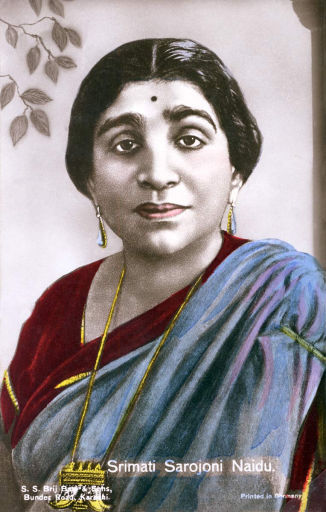
Gifted poet and fearless nationalist who fused lyrical art with mass politics, championing Indian freedom and women’s rights.
Conversation Starters
Life Journey
Born Sarojini Chattopadhyay in Hyderabad, then part of the princely state under British paramountcy. Her father Aghorenath Chattopadhyay was a scholar and educator, and her mother Barada Sundari Devi wrote poetry, shaping her early literary world.
She passed her matriculation examination unusually young, gaining notice in Hyderabad’s educational circles. Family encouragement and exposure to languages helped her craft early verse that mixed Indian imagery with English literary forms.
With support from the Nizam’s Hyderabad administration, she went to Britain to continue her education. The journey opened her to new intellectual networks and sharpened her sense of India’s place in an imperial world.
She studied in London and later at Girton College, Cambridge, where she met writers and critics who took her talent seriously. Mentors encouraged her to write about Indian subjects rather than imitate Victorian themes, strengthening her distinctive voice.
She married Dr. Govindarajulu Naidu, a physician, in a marriage notable for crossing community boundaries in colonial India. Their partnership supported her public life as she combined family responsibilities with literary and political work.
Her first major collection, The Golden Threshold, appeared in London and drew praise for musical language and Indian settings. The book helped earn her the nickname “Nightingale of India,” making her a celebrated public poet.
She began working more directly with the Indian National Congress as nationalism surged after Bengal’s partition. Her speeches blended moral argument with artistry, helping make political meetings accessible to wider audiences beyond elites.
The Bird of Time reinforced her reputation for lyrical portraits of Indian seasons, bazaars, and rituals. Literary fame increased her platform, allowing her to draw attention to social reform and women’s education in public addresses.
During World War I she supported relief and national service efforts that linked civic duty to political rights. These experiences deepened her conviction that Indians deserved self-government after contributing to imperial war needs.
She worked with leaders such as Annie Besant and other reformers to press for women’s enfranchisement and legal equality. Speaking to mixed audiences, she argued that freedom for India required political agency for Indian women as well.
The Amritsar massacre and the Rowlatt Act crackdown intensified her opposition to British rule. She used speeches and organizing to channel grief into disciplined protest, aligning increasingly with Gandhi’s emerging mass movement.
She toured and spoke in support of Gandhi’s Non-Cooperation movement, urging boycotts and constructive work. Her oratory helped translate political strategy into everyday actions, drawing students and women into nationalist activity.
At the Kanpur session she became the first Indian woman to preside over the Indian National Congress. The role highlighted her as a national unifier, trusted to bridge regional and ideological divides during a turbulent phase of politics.
She joined nationwide demonstrations opposing the Simon Commission because it excluded Indian representatives. Her public stance linked constitutional demands with mass agitation, reinforcing the claim that political reforms without Indians lacked legitimacy.
During the Civil Disobedience movement she supported the Salt March campaign and helped sustain protests when leaders were arrested. She was jailed by colonial authorities, and her imprisonment became a symbol of women’s frontline role in resistance.
She traveled and spoke abroad to explain India’s struggle and highlight women’s participation in nonviolent resistance. Her diplomacy blended moral persuasion with cultural presentation, strengthening international sympathy for self-rule.
When the Congress launched Quit India, she was arrested along with other senior leaders as the British moved to crush the uprising. Confinement tested her health, yet she continued to encourage steadfast nonviolent commitment within the movement.
India achieved independence amid Partition’s violence and displacement, reshaping the political landscape she had fought to transform. She used her standing to urge communal harmony and to protect vulnerable civilians during the transition.
She became Governor of the United Provinces, one of independent India’s most prominent administrative posts. The appointment signaled a new era for women in public office, and she emphasized civic reconciliation and institution-building.
She died while serving as governor, mourned as both a cultural icon and a freedom leader. Tributes from Congress colleagues and writers recalled her ability to make politics humane and poetic, shaping India’s public voice for decades.