Quick Facts
A brilliant Mexican nun-poet who fused baroque artistry with fearless intellect, defending women's learning in colonial society.
Conversation Starters
Life Journey
Juana Inés de Asbaje y Ramírez de Santillana was born near Popocatépetl in colonial New Spain. Raised outside marriage, she grew up amid haciendas and parish life, where books and Latin fascinated her early.
As a child she devoured her grandfather’s books and practiced reading and writing with unusual speed. Family accounts portray her composing early verses while demanding access to learning typically reserved for boys.
She entered the orbit of Mexico City’s elites to continue study beyond what rural life allowed. In the viceroyal capital, schools, libraries, and salons exposed her to theology, philosophy, and poetic fashions.
Juana became a protegée at the court associated with Viceroy Antonio Sebastián de Toledo and his circle. Courtly patronage gave her time and audience for poems, while sharpening her satirical and ceremonial style.
Seeking a life compatible with study, she attempted religious life with the Discalced Carmelites. The strict regime proved harsh, and the experiment was brief, but it clarified her desire for intellectual space.
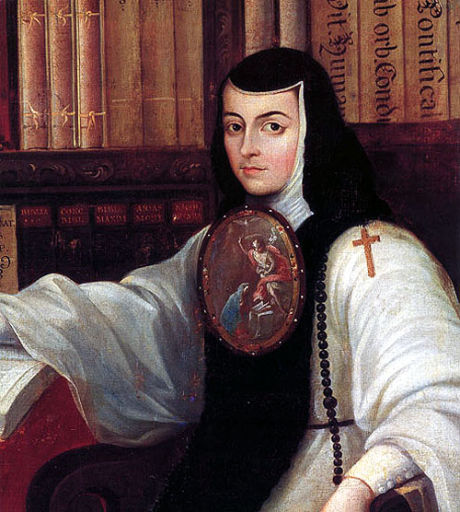
She took vows in the Convent of San Jerónimo, adopting the name Sor Juana Inés de la Cruz. The Hieronymite community allowed her a private cell, instruments, and a growing library that supported her scholarship.
Within San Jerónimo she assembled a famous library and corresponded with clerics and poets across New Spain. Her cell became an intellectual hub, where theology, music, and science met baroque literary technique.
Sor Juana produced villancicos and occasional poems for cathedrals and viceregal ceremonies. These commissions connected convent creativity to public festivals, blending sacred themes with sharp wit and learned allusion.
For the arrival of Viceroy Tomás de la Cerda y Aragón and Vicereine María Luisa Manrique de Lara, she wrote celebratory pieces. The pageantry of Mexico City provided a stage for her erudition and political tact.
The vicereine, a key patron, championed Sor Juana’s talent and circulated her poems among elite readers. This relationship amplified her fame while exposing her to scrutiny in a church-and-court culture wary of women’s authority.
Her works were gathered and printed in Madrid, extending her reputation beyond the Atlantic world. The publication placed a New Spanish nun in Iberian literary markets, where baroque poetry and theater were fiercely competitive.
A critique of a sermon by the Portuguese Jesuit António Vieira circulated under her name, provoking ecclesiastical alarm. The dispute framed her learning as a challenge to clerical authority, especially because she was a woman religious.
In a masterful defense addressed to 'Sor Filotea'—a pseudonym linked to Bishop Manuel Fernández de Santa Cruz—she justified women’s study. She cited Scripture, church fathers, and her own life to argue for intellectual vocation.
Her long poem 'Primero sueño' explored the mind’s ascent toward knowledge through dense baroque imagery. It fused classical philosophy, scholastic thought, and scientific curiosity, marking her as a singular thinker in colonial letters.
Amid intensified pressure from religious authorities and shifting politics, she curtailed intellectual work. Accounts describe her selling books and instruments, a dramatic retreat that symbolized the limits placed on female scholarship.
She focused on penitential practice and communal duties within San Jerónimo, turning from public literary life. The convent became her primary world again, where care for sisters and obedience replaced courtly recognition.
When disease swept through Mexico City, Sor Juana tended to sick nuns despite personal risk. Her service during the outbreak reflected her final shift from celebrated writer to caregiver within the cloister’s crisis.
She died in the convent after contracting illness while caring for others during the epidemic. Her death closed a brief, intense life that left New Spain an enduring literary legacy and a landmark defense of women’s intellect.