Quick Facts
A formidable court noblewoman whose family’s rise and fall ended in tragedy during Japan’s Genpei War.
Conversation Starters
Life Journey
Born as Tokiko in the late Heian period, she entered a world where Fujiwara-backed court factions competed for access to the throne. Her upbringing in Kyoto placed her close to rituals, rank, and the politics of imperial succession.
Tokiko married Taira no Kiyomori, whose military household was gaining favor through service to the court. The union strengthened clan cohesion and positioned her as a key manager of household alliances, attendants, and patronage in Kyoto.
In the Hogen Disturbance, rival imperial lines and their warrior supporters fought for control of Kyoto’s government. Kiyomori’s successes elevated the Taira, and Tokiko’s standing rose as the household became central to court power.
The Heiji Rebellion further weakened competing warrior networks and confirmed Kiyomori as a dominant force at court. Tokiko helped stabilize the family’s position by managing elite ties and presenting the Taira as protectors of imperial order.
As the Taira gained unprecedented access to the throne, Tokiko’s household became intertwined with the imperial family through marriages and court appointments. She navigated the etiquette of the palace while reinforcing the Taira’s legitimacy among nobles.
With Taira relatives holding high offices, Tokiko oversaw a powerful network of attendants, relatives, and allies in the capital. Her role as matriarch involved diplomacy with aristocratic families and careful control of access to Kiyomori’s household.
Tokiko’s grandson, Prince Tokihito, was born into a court already tense over succession and Taira dominance. His birth strengthened the family’s claim to be guardians of the realm, but it also deepened resentment among rival houses and warriors.
The child emperor Antoku was enthroned, and Tokiko became a central elder figure around the young sovereign and his mother, Kenreimon-in. Opposition rallied behind Prince Mochihito and Minamoto leaders, igniting the Genpei War across Japan.
As battles and uprisings threatened Kyoto, the Taira moved the court and imperial household under armed protection. Tokiko helped coordinate the dangerous relocation of women, children, and sacred objects while the Minamoto gained momentum in the east.
The Taira attempted to anchor authority at Fukuhara, closer to their maritime power base, but conditions proved difficult for courtiers. Tokiko witnessed how logistics, disease fears, and political backlash undermined the plan and forced a return toward Kyoto.
Kiyomori died, removing the Taira’s most formidable strategist at a critical moment in the Genpei War. Tokiko’s authority as senior matriarch became more visible as she supported heirs and protected Emperor Antoku’s precarious legitimacy.
Minamoto no Yoshinaka’s entry into Kyoto forced the Taira to flee with Emperor Antoku and key treasures symbolizing rightful rule. Tokiko joined the westward retreat, enduring hardship while the clan’s control of the capital collapsed.
A string of setbacks, including the fall of key positions, tightened the net around the Taira maritime court. Tokiko remained close to Antoku and Kenreimon-in, as the clan relied increasingly on ships, coastal allies, and dwindling resources.
On the eve of Dan-no-ura, the Taira fleet gathered in the straits, hoping local currents and naval skill would offset Minamoto strength. Tokiko stayed with the child emperor, aware that defeat could mean capture and the end of their imperial claim.
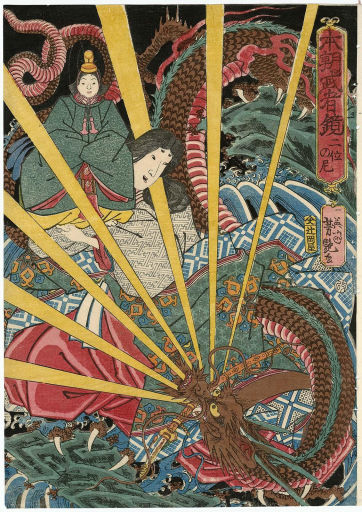
During the crushing defeat at Dan-no-ura, Tokiko took Emperor Antoku into her arms and leapt into the sea, choosing death over surrender. Chroniclers later emphasized the loss of the imperial regalia and the symbolic end of Taira rule in Japan.
After the war, Tokiko’s story was retold in The Tale of the Heike, blending history with moral reflection on impermanence. Her death became a powerful emblem of loyalty and tragedy, commemorated through memorial rites and later cultural portrayals.