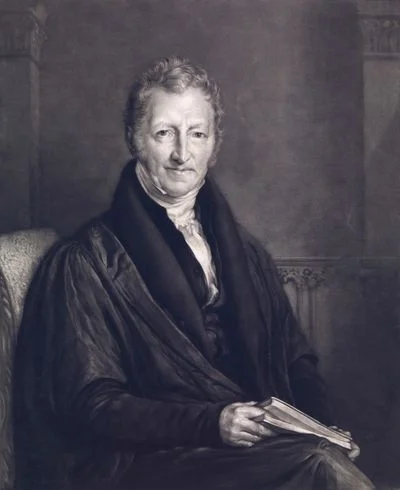
Quick Facts
Malthus: Population booms doom us all; resources will always fall short.
Conversation Starters
Life Journey
Thomas Robert Malthus was born into a prosperous family. His father Daniel was a friend of philosophers David Hume and Jean-Jacques Rousseau, exposing young Thomas to Enlightenment ideas from early childhood.
Malthus received his early education from private tutors including Gilbert Wakefield, a noted classical scholar. His father's progressive views ensured exposure to diverse intellectual perspectives.
Malthus entered Jesus College, Cambridge, to study mathematics and classics. Despite a speech impediment caused by a cleft palate, he excelled academically and became known for his debating skills.
Malthus earned his bachelor's degree, placing ninth in the prestigious mathematical tripos examination. His mathematical training would later inform his systematic approach to economic theory.
Following graduation, Malthus was ordained as an Anglican clergyman. He served as a curate in various parishes, combining pastoral duties with his growing intellectual pursuits in political economy.
Malthus was elected a Fellow of Jesus College, Cambridge, providing him with financial security and intellectual community. He remained a Fellow until his marriage required resignation by college rules.
Malthus anonymously published his revolutionary work arguing that population grows geometrically while food supply grows arithmetically. This disparity would inevitably lead to famine, disease, or war to check population.
Malthus traveled through Denmark, Norway, Sweden, Finland, and Russia collecting empirical data on population and resources. This research informed the expanded second edition of his famous Essay.
Malthus married his cousin Harriet Eckersall. The marriage was happy and produced three children. He was forced to resign his Cambridge fellowship upon marriage as required by college statutes.
Malthus became the first professor of history and political economy at the East India Company College at Haileybury. This was the first such professorship in Britain, establishing economics as an academic discipline.
Malthus began his celebrated intellectual debate with economist David Ricardo over rent, value, and economic theory. Despite disagreements, they maintained deep friendship and mutual respect until Ricardo's death.
Malthus published his comprehensive economic treatise, analyzing concepts of effective demand and economic gluts. His ideas on insufficient demand would later influence John Maynard Keynes's revolutionary theories.
Malthus became a founding member of the Political Economy Club, a gathering of leading economists and intellectuals. He actively participated in debates shaping economic thought of the era.
Malthus was elected Fellow of the Royal Society in recognition of his contributions to science and social theory. This honor acknowledged his systematic, empirical approach to studying population dynamics.
Malthus published the extensively revised sixth edition of his Essay, incorporating decades of additional research and responding to critics. It became the definitive version of his population theory.
Malthus became a founding member of the Statistical Society of London, promoting the use of data in social science. His emphasis on empirical evidence helped establish modern demographic methods.
Malthus testified before Parliament on reform of the Poor Laws, applying his population principles to social policy. His views influenced the controversial Poor Law Amendment Act of 1834.
Malthus died of heart disease in Bath. His population theory profoundly influenced Charles Darwin and Alfred Russel Wallace in developing natural selection. The term 'Malthusian' remains in use describing population-resource dynamics.