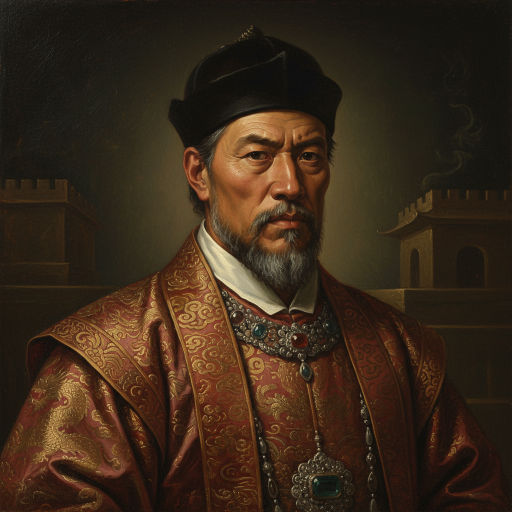
Quick Facts
A formidable Yuan court minister who steered reforms, commanded campaigns, and sponsored history-writing amid imperial decline.
Conversation Starters
Life Journey
Born into a powerful Mongol family within the Yuan dynasty’s aristocratic circles. His early status positioned him to enter the capital’s competitive world of palace patronage, factional rivalry, and high office.
As a teenager, he began serving in court-connected posts that relied on Mongol noble ties rather than the Chinese examination track. He learned the mechanics of the Secretariat, the Censorate, and the emperor-centered politics of Dadu.
During years of quick successions and sharp factional struggles, he gained prominence as a forceful organizer and advocate. Court turmoil made loyalty and effectiveness valuable commodities, helping him rise faster than many peers.
He was entrusted with major responsibilities in the central administration as Emperor Toghon Temur’s court sought capable managers. The appointments brought him into direct conflict with entrenched interests benefiting from corruption and exemptions.
He emerged as one of the most influential ministers guiding policy from the capital. His authority depended on controlling appointments, revenue channels, and the flow of memorials that shaped the emperor’s decisions.
He pushed reforms aimed at repairing revenue collection, restraining abuses by powerful households, and improving administrative discipline. These measures were meant to shore up Yuan legitimacy as famine, banditry, and discontent spread in the provinces.
He backed large scholarly teams to compile the official histories of the Liao, Jin, and Song dynasties under Yuan auspices. The project asserted Yuan authority over the Chinese historical tradition and trained officials in orthodox political lessons.
Under his patronage, editors produced the Liao Shi, Jin Shi, and Song Shi for presentation to the throne. The works reinforced continuity of rule while also exposing how dynasties collapsed, a warning increasingly relevant to the Yuan court.
State planners faced recurring Yellow River disasters that damaged farmland and disrupted the Grand Canal supply system. He supported ambitious hydraulic and logistics measures to protect tax grain routes feeding Dadu and the northern garrisons.
His consolidation of power generated enemies among court factions competing for access to Emperor Toghon Temur. Accusations of overreach and favoritism circulated in memorials, foreshadowing the precariousness of ministerial dominance in late Yuan politics.
The Red Turban movement erupted amid hardship, religious mobilization, and resentment of Yuan taxation and labor demands. The court looked to him to coordinate provincial responses as rebellions spread across the Huai River and lower Yangtze regions.
He supervised deployments that drew on Yuan garrisons, local militias, and loyalist commanders while trying to keep the treasury solvent. The campaigns exposed deep weaknesses in command cohesion and the difficulty of sustaining troops across vast distances.
He took a direct role in operations aimed at restoring control over key nodes linking the canal and coastal routes. Fighting around fortified towns and supply lines demonstrated that the rebellion was becoming a state-breaking civil war.
As the situation deteriorated, rivals used battlefield reverses and fiscal strain to undermine his position with Emperor Toghon Temur. He was dismissed and politically isolated, illustrating how late Yuan governance was crippled by factional vendettas.
After losing protection at court, he was expelled from the center of power and ordered to die. His execution removed one of the dynasty’s strongest ministers at the very moment rebellions were closing in on vital regions and revenues.