Quick Facts
Name of the Rose. Semiotician who made medieval mysteries bestsellers.
Conversation Starters
Life Journey
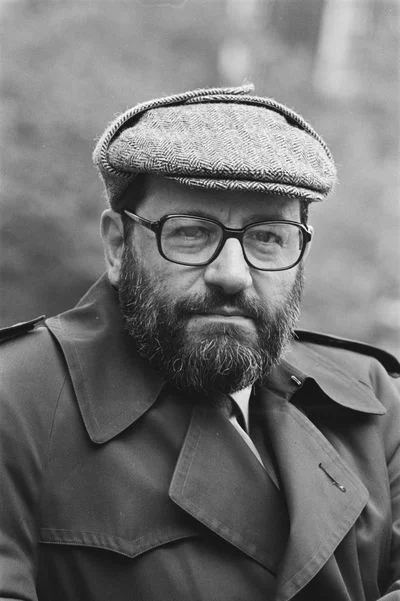
Umberto Eco was born on January 5, 1932, into a middle-class family. His father Giulio was an accountant who was drafted into three wars. The family moved to Turin during World War II to escape bombing raids.
Young Eco became deeply involved in Catholic youth movements, serving as a national leader of the Gioventù Studentesca Cattolica Italiana. This experience with Catholic doctrine and medieval thought would profoundly influence his academic work.
Eco completed his doctoral dissertation on the aesthetics of Thomas Aquinas at the University of Turin. This study of medieval scholastic thought launched his career as a philosopher and established his expertise in semiotics and interpretation.
Eco published 'Il problema estetico in San Tommaso,' his revised dissertation on Aquinas's aesthetics. The work demonstrated his ability to make complex medieval philosophy accessible while establishing his scholarly credentials.
Eco began working for RAI, Italy's national broadcasting company, as an editor for cultural programming. This experience with mass media would later inform his groundbreaking analyses of popular culture and communication.
Eco's influential essay collection introduced the concept of 'open' texts that allow multiple interpretations. The work challenged traditional notions of authorial intention and became foundational for reader-response theory and postmodern criticism.
Eco married Renate Ramge, a German art teacher. Their marriage lasted over fifty years until his death, producing two children: a son Stefano and a daughter Carlotta, who both became involved in creative professions.
Eco received his first university teaching position at the University of Florence as lecturer in aesthetics. He would go on to teach at various Italian universities before finding his permanent home at the University of Bologna.
Eco became the first professor of semiotics at the University of Bologna, establishing the discipline as an academic field. He would remain associated with Bologna for the rest of his career, building it into a center for semiotic studies.
Eco published his systematic treatise on semiotics, establishing himself as a leading figure in the field alongside Peirce and Saussure. The work provided a comprehensive framework for understanding signs and communication systems.
Eco co-founded VS (Versus), a major international semiotics journal. His editorial work helped establish academic networks and promoted semiotic research across disciplines and national boundaries.
Eco's first novel combined a medieval murder mystery with semiotics, philosophy, and literary theory. The book became a global phenomenon, selling over 50 million copies and proving that intellectual fiction could achieve mass popularity.
Jean-Jacques Annaud's film adaptation starring Sean Connery brought Eco's novel to millions more readers. Though Eco had reservations about film adaptations, the movie's success cemented his status as a cultural figure beyond academia.
Eco's second novel explored conspiracy theories, occultism, and the nature of interpretation. The complex, erudite work challenged readers with its dense references while satirizing the human tendency to find patterns everywhere.
Eco's third novel, set in the 17th century, explored themes of time, science, and the nature of narrative itself. The baroque story demonstrated his continued ability to blend intellectual inquiry with engaging storytelling.
Eco's fourth novel followed a medieval peasant who becomes a confidant of Frederick Barbarossa. The book explored themes of lying, myth-making, and the creation of history, drawing on Eco's expertise in medieval culture.
Eco's most autobiographical novel explored memory and identity through a rare book dealer who loses his personal memories. The heavily illustrated work incorporated images from Eco's own collection of vintage publications.
Umberto Eco died on February 19, 2016, of pancreatic cancer. He left behind a vast intellectual legacy: seven novels, dozens of academic works, a personal library of over 50,000 volumes, and a transformed understanding of popular culture and semiotics.