Quick Facts
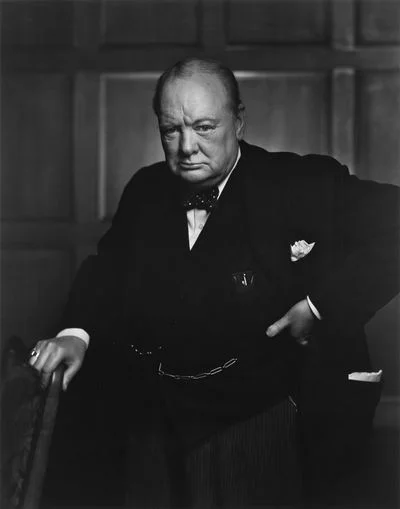
We shall fight on": Churchill led Britain through its darkest hour.
Conversation Starters
Life Journey
Winston Leonard Spencer Churchill was born at Blenheim Palace, the ancestral home of the Dukes of Marlborough. His father was Lord Randolph Churchill, a prominent Conservative politician.
Churchill was sent to St George's School in Ascot. He struggled academically and was often unhappy, later describing harsh treatment he received there.
Churchill enrolled at Harrow School where he excelled in English and history while struggling with classics. He joined the Rifle Corps and won a fencing championship.
After three attempts, Churchill was admitted to the Royal Military College at Sandhurst. He graduated eighth in his class of 150 in December 1894.
Churchill was commissioned as a second lieutenant in the 4th Queen's Own Hussars. He also began his journalism career, traveling to Cuba to report on the rebellion.
Churchill saw action on the North-West Frontier of India. He wrote dispatches for the Daily Telegraph and later published 'The Story of the Malakand Field Force.'
Churchill participated in the last great British cavalry charge at the Battle of Omdurman. He wrote 'The River War' based on this campaign against the Mahdist forces.
Churchill was captured by Boers while reporting on the war. He made a daring escape from prison in Pretoria, traveling 300 miles to Portuguese territory, becoming a national hero.
Churchill was elected to Parliament as Conservative MP for Oldham. He soon gained attention for his oratory and independent stance on various political issues.
Disillusioned with Conservative policies on tariffs and trade, Churchill dramatically crossed the floor of the House of Commons to join the Liberal Party.
Churchill married Clementine Hozier at St. Margaret's Church, Westminster. Their marriage lasted 56 years and produced five children. She was his devoted partner and advisor.
Churchill was appointed First Lord of the Admiralty, modernizing the Royal Navy for World War I. He converted the fleet from coal to oil and established the Royal Naval Air Service.
The failed Gallipoli Campaign led to Churchill's resignation from the Admiralty. He briefly served as an infantry officer in the trenches of France before returning to politics.
Churchill rejoined the Conservatives and was elected MP for Epping. He was appointed Chancellor of the Exchequer by Stanley Baldwin, serving until 1929.
Churchill became Prime Minister as Nazi Germany invaded Western Europe. His speeches rallied the British nation during its darkest hour, vowing 'never surrender' to Hitler.
Churchill and President Roosevelt signed the Atlantic Charter, outlining Allied goals for the post-war world. This cemented the 'special relationship' between Britain and America.
Churchill met with Roosevelt and Stalin at Tehran to coordinate Allied strategy. They agreed on Operation Overlord, the invasion of Normandy, for May 1944.
Churchill led Britain to victory in Europe but lost the general election to Labour. Despite this, he remained active in opposition and warned of the 'Iron Curtain' descending across Europe.
Churchill was awarded the Nobel Prize in Literature for his historical and biographical works and oratory. He was also knighted as a Knight of the Garter by Queen Elizabeth II.
Churchill died at his London home, exactly 70 years after his father's death. He received a state funeral at St Paul's Cathedral, attended by representatives from 112 nations.