Quick Facts
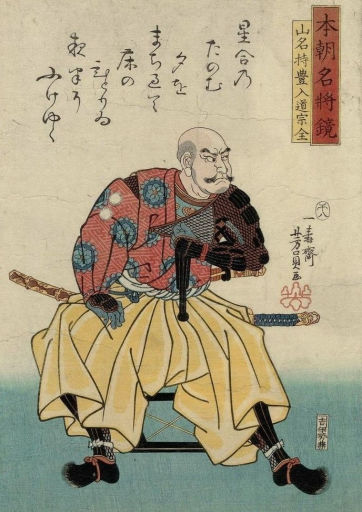
A fiercely ambitious samurai powerbroker whose rivalry helped ignite the Onin War and fracture Muromachi Japan.
Conversation Starters
Life Journey
Born as Yamana Mochitoyo into the powerful Yamana family, a leading shugo-daimyo house under the Ashikaga shogunate. He grew up as regional military governors competed for influence while Kyoto politics shaped appointments and alliances.
As a teenager he was educated in the martial skills and administrative practices expected of a shugo governor. Senior Yamana retainers instructed him in levy management, castle defense, and courtly protocol needed to operate in Kyoto.
Entering adult service, he took on field leadership for Yamana forces and learned coalition warfare among neighboring houses. Early campaigns and policing duties sharpened his sense that rank in Kyoto could be converted into provincial power.
He cultivated ties in the Ashikaga government, using petitions and patronage to strengthen Yamana claims to governorships. By balancing court connections with military readiness, he positioned himself as a formidable actor in Muromachi factionalism.
After shogun Ashikaga Yoshinori was assassinated in the Kakitsu Incident, Kyoto descended into anxiety and opportunism. He maneuvered carefully among rival families to preserve Yamana holdings while the shogunate searched for stability.
He reinforced Yamana authority by reorganizing vassal obligations and securing key fortifications and roads. These measures increased revenue and troop mobilization, ensuring the clan could project power beyond the capital’s shifting alliances.
He adopted the religious name Sōzen, a common practice among elite warriors seeking prestige and legitimacy. Around this time he became notorious for uncompromising decisions in disputes, earning a fearsome public image among Kyoto courtiers.
Conflicts over shogunal offices and provincial assignments intensified as he challenged competing houses for influence. His confrontations helped crystallize two major political camps, laying groundwork for later warfare centered on Kyoto’s governance.
His rivalry with Hosokawa Katsumoto hardened into a bitter struggle for dominance inside the Ashikaga administration. Both leaders recruited allies among shugo and court nobles, turning policy disputes into armed readiness around the capital.
As succession tensions grew under shogun Ashikaga Yoshimasa, he supported a faction that promised advantages for the Yamana. The dispute entangled aristocrats, temple interests, and provincial governors, making compromise increasingly fragile.
He brought Yamana allies into the capital and prepared for urban conflict by securing residences and defensive lines. Kyoto’s neighborhoods became militarized spaces, with temples, mansions, and streets repurposed for siege and supply.
Negotiations repeatedly failed as both camps feared losing face and offices within the shogunate. His faction and the Hosokawa side stockpiled troops and provisions, turning political deadlock into a crisis that threatened Kyoto’s survival.
Open fighting erupted in Kyoto, and he commanded the Yamana-aligned coalition against Hosokawa Katsumoto. Battles spread through the capital’s wards, burning estates and temples and marking the start of a conflict that undermined Muromachi order.
With neither side able to secure a decisive victory, the war devolved into grinding block-by-block fighting and shifting alliances. He struggled to maintain cohesion among provincial allies as supplies dwindled and Kyoto’s economy collapsed.
As the conflict dragged on, provincial commanders increasingly pursued their own agendas rather than shogunal directives. He saw how the capital’s paralysis encouraged local power consolidation, a key dynamic leading toward the Sengoku era.
He died while the Onin War still raged, leaving the Yamana faction without its most formidable strategist. His death, followed shortly by Hosokawa Katsumoto’s, removed both principal leaders but did not end the violence consuming Kyoto.