Quick Facts
Yusuf ibn Tashfin: Almoravid founder; North Africa and Spain trembled before him.
Conversation Starters
Life Journey
Yusuf ibn Tashfin was born into the Lamtuna clan of the Sanhaja Berbers in the Sahara Desert. He would rise to become one of the greatest Muslim rulers of medieval Africa and Spain.
Young Yusuf received education in Berber traditions, horsemanship, and desert warfare. He also studied Islamic jurisprudence under the strict Maliki school that would define Almoravid ideology.
Yusuf joined the nascent Almoravid movement founded by Abdullah ibn Yasin, a religious reformer seeking to spread strict Islamic observance among the Berber tribes of the Sahara.
Yusuf rose to become a prominent military commander within the Almoravid forces, distinguishing himself through tactical brilliance and personal courage in battles against rival Berber tribes.
Yusuf led the Almoravid armies northward from the Sahara into Morocco, beginning the conquest that would create one of the largest empires in medieval African history.
Following the death of Abu Bakr ibn Umar, Yusuf assumed supreme leadership of the Almoravid movement, taking the title of Amir al-Muslimin (Commander of the Muslims).
Yusuf founded Marrakech as the capital of his growing empire. The city would become a major center of Islamic learning, trade, and culture, rivaling the great cities of the Islamic world.
Yusuf married Zaynab al-Nafzawiyyah, a wealthy and politically astute woman who had previously been married to Abu Bakr. She became his chief advisor and helped consolidate his power.
Yusuf captured Fez and brought all of northern Morocco under Almoravid control. His empire now stretched from the Sahara to the Mediterranean Sea.
By 1080, Yusuf had unified all of Morocco under Almoravid rule. He established an efficient administration and promoted trade across the Saharan routes.
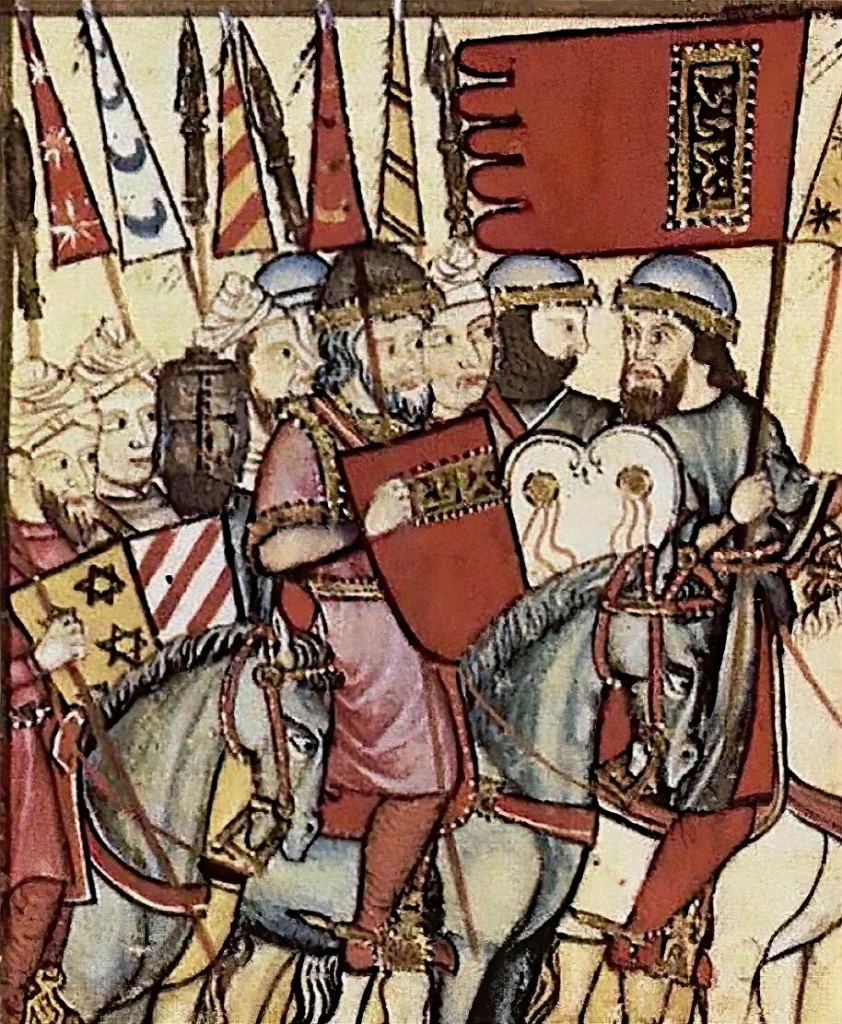
In his greatest military triumph, Yusuf crossed into Spain and decisively defeated King Alfonso VI of León and Castile at the Battle of Sagrajas. This victory halted the Christian Reconquista for decades.
Yusuf returned to Spain multiple times to support the Muslim Taifa kingdoms against Christian advances. His military campaigns preserved Islamic rule in much of the Iberian Peninsula.
Viewing the Taifa kings as corrupt and ineffective, Yusuf began annexing their kingdoms directly into the Almoravid Empire, unifying Muslim Spain under his rule.
The Abbasid Caliph in Baghdad officially recognized Yusuf's authority, granting him the title Amir al-Muslimin. This confirmed his status as the supreme Muslim leader in the West.
The Almoravid Empire reached its maximum extent under Yusuf, stretching from the Sahara to central Spain and from the Atlantic to Algeria. It was the largest empire in the western Islamic world.
The aging Yusuf formally appointed his son Ali ibn Yusuf as his heir and began gradually transferring administrative responsibilities to ensure a smooth succession.
Despite ruling a vast empire, Yusuf maintained the austere Almoravid lifestyle throughout his reign. He wore simple clothing, ate modestly, and devoted himself to prayer and Islamic scholarship.
Yusuf ibn Tashfin died in Marrakech at approximately 100 years of age, leaving behind a vast empire and a legacy as one of medieval Islam's greatest rulers. He was succeeded by his son Ali.