Quick Facts
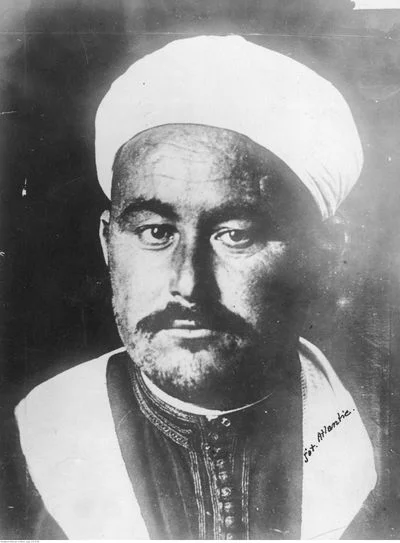
Father of guerrilla warfare. Led the Rif rebellion that humbled Spanish and French colonial armies.
Conversation Starters
Life Journey
Muhammad ibn Abd el-Krim el-Khattabi was born to a prominent Berber family of the Aith Waryaghar tribe in the Rif Mountains, where his father was a respected judge and religious scholar.
Abd el-Krim received traditional Islamic education from his father, memorizing the Quran and studying Arabic grammar, laying the foundation for his later intellectual pursuits.
Abd el-Krim traveled to Fez to study at the renowned Qarawiyyin University, one of the world's oldest universities, where he deepened his knowledge of Islamic law and Arabic literature.
Abd el-Krim began working for the Spanish colonial administration in Melilla as a judge and teacher, while also writing for the Spanish-Arabic newspaper El Telegrama del Rif.
Abd el-Krim was promoted to chief qadi (Islamic judge) for the Melilla region, gaining valuable experience in administration while maintaining relationships with tribal leaders.
Spanish authorities arrested Abd el-Krim on suspicion of communicating with Germany during World War I. During his imprisonment, he injured his leg in an escape attempt, causing a permanent limp.
After his father's death, possibly by Spanish poisoning, Abd el-Krim inherited leadership of his tribe and began organizing armed resistance against Spanish colonial expansion into the Rif.
Abd el-Krim led Riffian forces to a devastating victory at the Battle of Annual, killing over 8,000 Spanish troops including General Silvestre. This became known as the Disaster of Annual.
Abd el-Krim proclaimed the independent Republic of the Rif with a modern constitution, legislative assembly, and government ministries, becoming its first president.
Abd el-Krim established a disciplined Riffian army with modern tactics, using captured Spanish weapons and implementing guerrilla warfare strategies that would later influence revolutionary movements worldwide.
As president, Abd el-Krim implemented reforms including taxation systems, infrastructure development, and diplomatic outreach to European powers seeking international recognition.
Abd el-Krim expanded military operations against French forces in Morocco, capturing numerous French posts and threatening the French protectorate, forcing France to join Spain in opposing him.
A massive combined force of over 250,000 French and Spanish troops, supported by tanks, aircraft, and chemical weapons, launched a coordinated offensive against the Rif Republic.
Overwhelmed by superior Franco-Spanish forces and facing devastating chemical weapon attacks on civilian populations, Abd el-Krim surrendered to French Marshal Petain to spare his people further suffering.
France exiled Abd el-Krim and his family to the remote island of Reunion in the Indian Ocean, where he would spend the next two decades as a political prisoner.
While being transferred to France, Abd el-Krim escaped during a stop at Port Said and was granted asylum by King Farouk of Egypt, becoming a symbol of anti-colonial resistance.
Abd el-Krim founded and led the Liberation Committee of the Arab Maghreb in Cairo, supporting independence movements across North Africa and inspiring a new generation of revolutionaries.
Abd el-Krim died in Cairo, having refused offers to return to Morocco under King Hassan II. He remains a hero of anti-colonial resistance, with his tactics studied by revolutionaries including Ho Chi Minh and Che Guevara.