Quick Facts
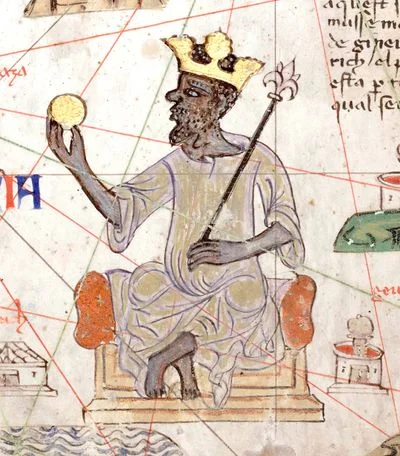
He seized power by force and held it through wisdom. Under his reign, Songhai became West Africa's greatest empire—and Timbuktu, its intellectual heart.
Conversation Starters
Life Journey
Muhammad Ture was born into the Soninke ethnic group in the Songhai Empire. He would rise from military commander to become one of Africas greatest emperors, transforming Songhai into a center of Islamic learning.
Muhammad Ture entered military service under Sunni Ali, the warrior king who was expanding the Songhai Empire. He proved himself an exceptional commander and rose through the ranks.
Muhammad Ture became one of Sunni Alis most trusted generals. He participated in campaigns that expanded Songhai control over the Niger River valley and the wealthy trading cities of the Sahel.
Sunni Ali died and was succeeded by his son Sunni Baru. Muhammad Ture, a devout Muslim, opposed Baru who was seen as insufficiently Islamic and hostile to the Muslim scholarly class.
Muhammad Ture defeated Sunni Baru at the Battle of Anfao and seized the throne. He took the title Askia, founding a new dynasty and transforming Songhai into a thoroughly Islamic state.
Askia Muhammad made a magnificent pilgrimage to Mecca with thousands of followers and enormous quantities of gold. He met with scholars and the Abbasid Caliph, who recognized him as Caliph of the Sudan.
Askia Muhammad returned from Mecca with Islamic scholars and books. He established Timbuktu and Djenne as major centers of Islamic learning, attracting scholars from across the Muslim world.
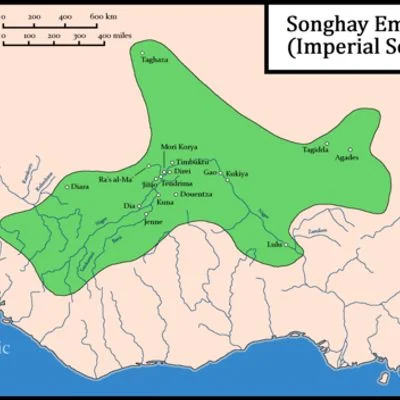
Askia Muhammad launched campaigns westward, conquering the remnants of the Mali Empire and extending Songhai control to the Atlantic coast. His empire became the largest in African history.
Askia Muhammad implemented comprehensive administrative reforms, dividing the empire into provinces with appointed governors. He standardized weights, measures, and established a professional bureaucracy.
Askia Muhammad conquered the Hausa city-states to the east, including Kano and Katsina. This expansion brought wealthy trading centers under Songhai control and spread Islamic influence.
Askia Muhammad established Islamic courts and law throughout his empire. He consulted with the scholar al-Maghili on proper Islamic governance and worked to eliminate non-Islamic practices.
Askia Muhammad greatly expanded the University of Sankore in Timbuktu, which became one of the worlds great centers of learning with thousands of students studying Islamic sciences, law, and literature.
Askia Muhammad began losing his sight in old age. His declining health led to succession struggles among his sons, weakening his control over the vast empire he had built.
Askia Muhammads son Musa deposed his blind and aged father in a palace coup. The old emperor was exiled to an island in the Niger River, ending his 35-year reign.
From exile, Askia Muhammad witnessed his sons fighting civil wars over the succession. Musa was overthrown by another son, beginning a period of instability.
Askia Muhammad was finally restored to honor by his son Askia Ismail, who brought the aged former emperor back to Gao. He spent his final months in dignity at the capital.
Askia Muhammad died at approximately 96 years old. He was buried in the Tomb of Askia in Gao, now a UNESCO World Heritage Site. He is remembered as one of Africas greatest rulers and a champion of Islamic learning.